
What the Marine vs Beef Collagen Debate Is Really About
When comparing marine vs beef collagen, the honest answer is that neither is universally better. The right choice depends on your health goals, dietary needs and budget.
Quick answer for South African buyers:
| Goal | Better Choice |
|---|---|
| Skin hydration, elasticity and fine lines | Marine collagen (Type I focus, smaller peptides) |
| Joint comfort and gut lining support | Bovine collagen (Type I + Type III) |
| Hair and nail strength | Either works well |
| Pescatarian or halaal diet | Marine collagen (from permitted fish) |
| Beef allergy or avoidance | Marine collagen |
| Fish or seafood allergy | Bovine collagen |
| Best value for daily use | Bovine collagen |
| Broader connective tissue support | Bovine collagen |
Both types are derived from animal by-products and broken down into hydrolysed peptides that your body can absorb and use. Marine collagen comes from fish skin and scales and is predominantly Type I collagen. Bovine collagen comes from cow hide and connective tissue and contains both Type I and Type III collagen.
The differences in absorption, collagen type and price are real but are often exaggerated by marketing. What matters most is that you choose a clean, hydrolysed product, take an effective daily dose and stick to it consistently for at least 8 to 12 weeks.
This guide cuts through the noise so you can make a clear, informed decision.
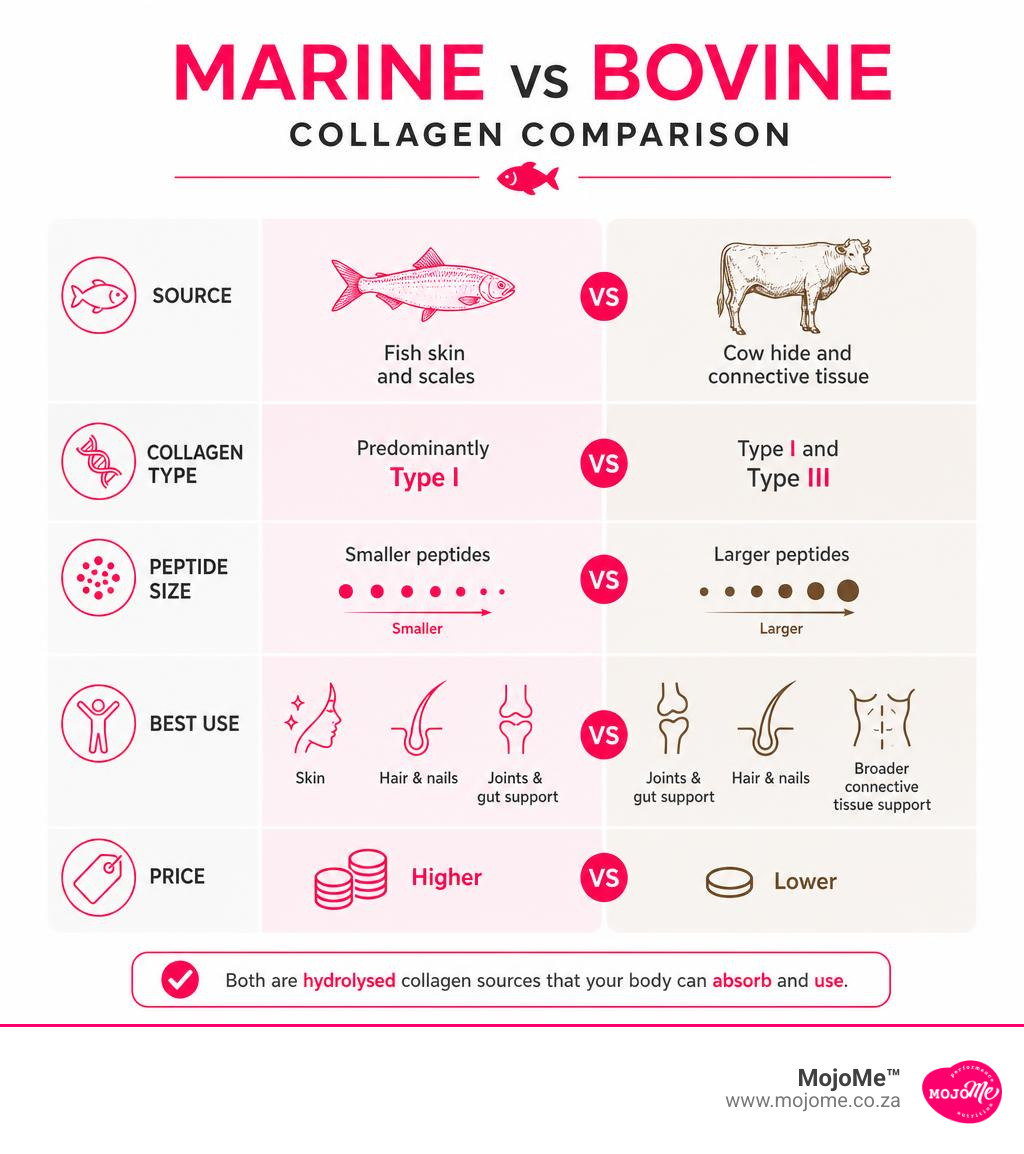
Simple marine vs beef collagen word guide:
The Short Answer: Choosing Between Marine and Bovine Collagen
If you want a fast decision, use this:
- Choose marine collagen if your main goal is skin support, you prefer a fish source or you avoid beef.
- Choose bovine collagen if you want better value per gram, broader Type I and Type III support or you are focused on joints, gut lining and connective tissue.
- Choose either if your main goals are hair and nail support, provided the product is hydrolysed, clean and taken consistently.
- Avoid marine collagen if you have a fish or seafood allergy.
- Avoid bovine collagen if you do not consume beef for dietary, religious, cultural or medical reasons.
The most practical truth is this: the best collagen is the one you can take daily without fighting the taste, cost or your own values.
| Feature | Marine Collagen | Bovine Collagen |
|---|---|---|
| Source | Fish skin, scales and bones | Cow hide, bones and connective tissue |
| Main collagen type | Mostly Type I | Type I and Type III |
| Best known for | Skin, hair and nails | Joints, gut, skin and overall connective tissue |
| Amino acids | Glycine, proline, hydroxyproline and often more alanine | Glycine, proline, hydroxyproline and often more glycine |
| Absorption | Often smaller peptides | Excellent if properly hydrolysed |
| Allergy concern | Fish or seafood allergy | Beef allergy or beef avoidance |
| Diet fit | Pescatarian-friendly | Not suitable for pescatarians |
| Typical cost | Usually higher per gram | Usually better value per gram |
| Sustainability angle | Can use fish industry by-products | Can use cattle industry by-products |
Marine vs Beef Collagen at a Glance
Marine collagen is usually made from fish skin and scales. It is mostly Type I collagen, the main collagen type found in skin, tendons and bones. This is why marine collagen is often positioned as the beauty-focused option.
Bovine collagen is usually made from cow hide and connective tissue. It contains Type I and Type III collagen. Type III is found alongside Type I in skin, blood vessels, organs and the gut lining. This makes bovine collagen a strong all-rounder.
A useful marine and bovine collagen overview also notes the same core distinction: marine is mostly Type I while bovine gives Type I plus Type III.
The real decision is not “Which animal wins?” It is “Which source fits your body, your budget and your daily routine?”
Which One Should South Africans Choose First?
For most South African buyers, we suggest starting with your main goal:
- Skin-first goal: choose marine collagen if the budget allows.
- Joint, gut or broad wellness goal: choose bovine collagen.
- Best long-term value: choose bovine collagen.
- Pescatarian lifestyle: choose marine collagen.
- Fish allergy: choose bovine collagen.
- Beef avoidance: choose marine collagen.
- Halaal needs: check certification and source details before buying.
South African supplement habits are shaped by price, availability, diet and trust. A product that looks good online but costs too much to use daily is not a great plan. Collagen works best as a habit, not as an occasional panic powder before a wedding.
For a practical local decision guide, read our article on which collagen you should actually swallow.
What Marine and Bovine Collagen Are Made From
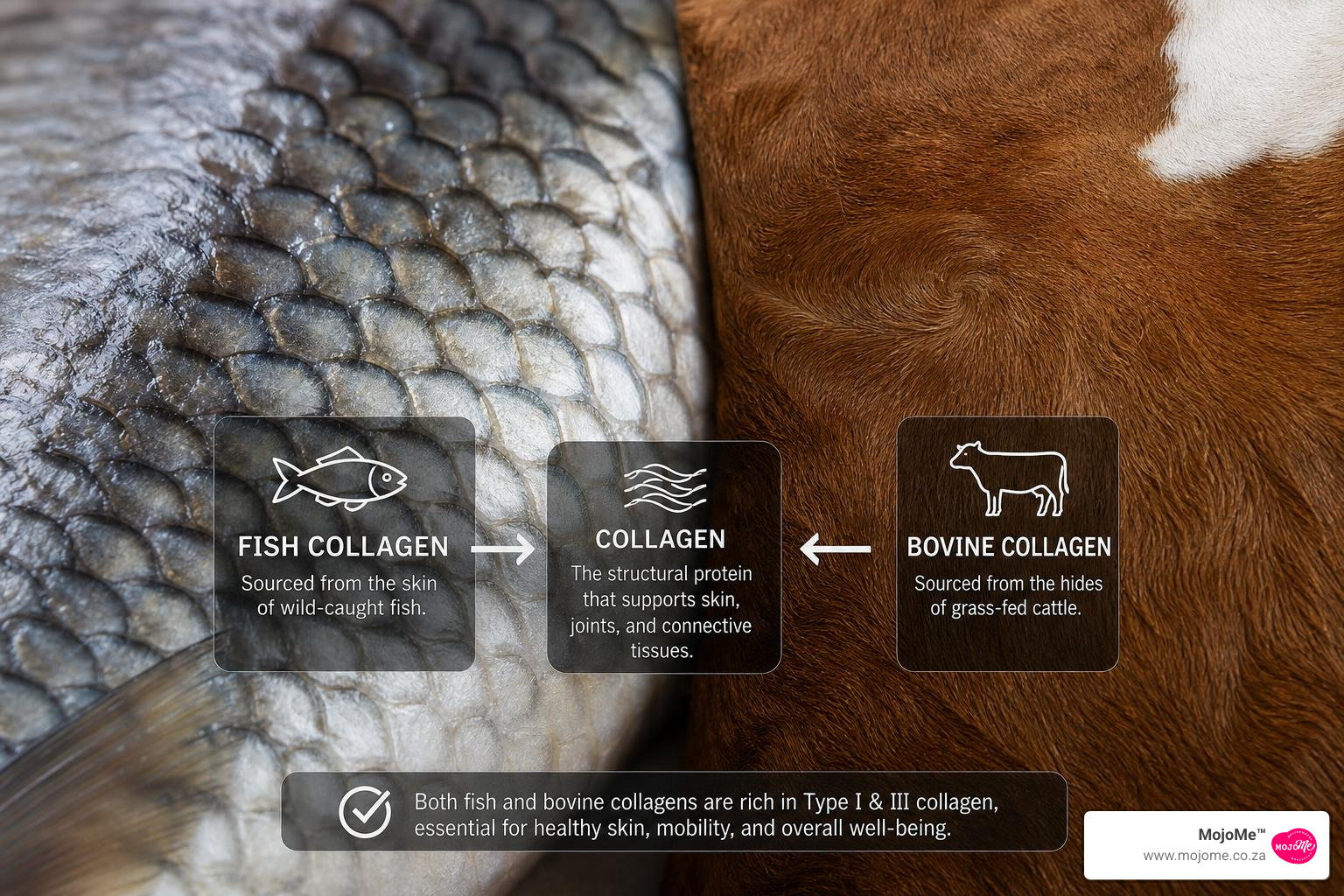
Collagen supplements are made by extracting collagen-rich tissue from animal by-products and breaking it down through hydrolysis. Hydrolysis turns large collagen proteins into smaller collagen peptides.
These peptides are rich in amino acids such as:
- Glycine
- Proline
- Hydroxyproline
- Alanine
- Arginine
Your body does not swallow collagen and send it directly to your cheekbones or knees like a courier with GPS. It breaks peptides into smaller units, absorbs them and uses the amino acids and peptide signals to support collagen turnover where needed.
Clean formulation matters. At MojoMe, we focus on natural supplements without unnecessary fillers, sugars, gluten or grains because the extras should not get in the way of the active ingredient.
Marine Collagen: Fish Source, Type I Focus and Amino Acid Profile
Marine collagen comes from fish skin, scales, bones or fins. Good marine collagen often uses parts of the fish that would otherwise be wasted.
Marine collagen is mostly Type I collagen. Type I is the most abundant collagen type in the human body and is especially important for:
- Skin structure
- Tendons
- Bones
- Ligaments
- Hair and nail support
Marine collagen is often praised for its smaller peptide size. Typical commercial marine peptides are often reported around 2 000 to 3 000 Daltons, though this depends on processing quality.
Amino acid-wise, marine collagen contains glycine, proline and hydroxyproline. It may also contain relatively more alanine than bovine collagen, depending on the fish species and processing method.
Marine collagen may suit you if you follow a pescatarian diet, avoid beef or want a Type I-focused product. If this is your direction, read more about why wild caught marine collagen matters.
Bovine Collagen: Beef Source, Type I and Type III Coverage
Bovine collagen comes from cattle, usually from cow hide, bones and connective tissue. It is naturally rich in Type I and Type III collagen.
This makes it useful for supporting:
- Skin structure
- Tendons and ligaments
- Joint comfort
- Gut lining support
- Muscles and organs
- General connective tissue maintenance
Bovine collagen is usually more affordable per gram than marine collagen. That matters because collagen is taken in gram-level daily amounts, not tiny milligram doses. If a product is too expensive to use consistently, the theoretical benefits may never become practical benefits.
Quality matters here too. Look for grass-fed or responsibly sourced bovine collagen, transparent labelling and contaminant screening. For more detail, see our guide to grass-fed beef collagen.
Why Collagen Type Matters Less Than People Think
Collagen type does matter, but not as much as many labels suggest.
Marine collagen is mostly Type I. Bovine collagen is Type I and III. Type II collagen, which is found in cartilage, is a different category often sourced from chicken sternum and used differently, especially when undenatured.
However, hydrolysed collagen peptides do not simply rebuild the exact same collagen type in a straight line. They provide amino acids and bioactive peptides that may signal fibroblasts and other cells involved in collagen production.
In plain English: your body is smarter than the label.
Also important: collagen is not a complete protein. It is low in tryptophan and should not replace complete dietary protein from foods such as eggs, fish, meat, dairy, legumes or other suitable sources.
Marine vs Beef Collagen Bioavailability: What the Research Really Says
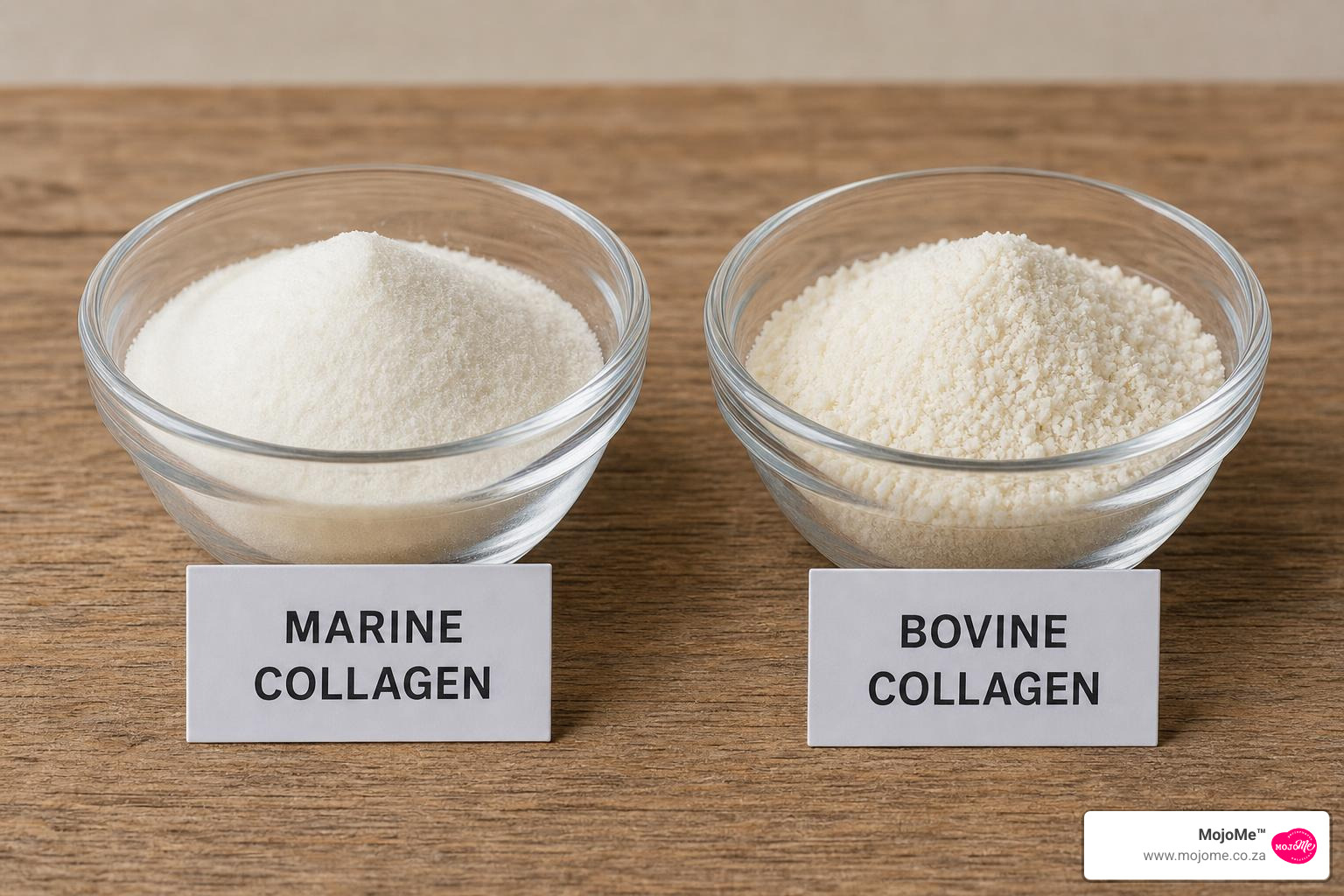
Bioavailability means how well your body absorbs and uses a nutrient.
In collagen, bioavailability is affected by:
- Peptide size
- Degree of hydrolysis
- Manufacturing quality
- Dose
- Consistency
- Individual digestion
- Whether the product is actually taken daily
The common claim is that marine collagen peptides are absorbed up to 1.5 times more efficiently than bovine collagen because they are smaller. There is some basis for this, but it needs context.
Peptide Size, Hydrolysis and Absorption
Collagen peptides are absorbed mainly as amino acids, dipeptides and tripeptides. These small peptide fragments can be transported through the gut using peptide transporters such as PEPT1.
Typical reported peptide sizes are:
- Marine collagen peptides: around 2 000 to 3 000 Daltons
- Bovine collagen peptides: around 3 000 to 8 000 Daltons
Smaller peptides can be easier to absorb. But source is not the only factor. Hydrolysis quality can matter more than whether the collagen came from fish or cattle.
A highly hydrolysed bovine collagen can absorb very well. A poorly processed marine collagen may not live up to the marketing.
Does Marine Really Absorb Better Than Bovine?
Marine collagen often has a bioavailability advantage because it is commonly processed into smaller peptides. This is where the “1.5 times better absorbed” claim comes from.
But the gap narrows when bovine collagen is also hydrolysed to a low molecular weight. Current evidence does not show that marine collagen produces clearly superior human outcomes in every category.
So the honest answer is:
- Marine collagen may absorb faster or more efficiently in typical commercial forms.
- Properly hydrolysed bovine collagen is also highly absorbable.
- Clinical results depend more on dose, quality and consistency than source alone.
We unpack this in more detail here: is fish collagen really better than beef?
What Current Studies Suggest for Results
Research on collagen peptides generally supports benefits for skin hydration, elasticity and wrinkle measures when taken consistently. Many studies use daily doses between 2.5 g and 10 g, often for 8 to 12 weeks.
For skin, both marine and bovine collagen have supportive evidence. Marine collagen has a strong Type I beauty positioning, but bovine collagen has also been used successfully in skin studies.
For joints, bovine collagen has a strong evidence base, especially for joint comfort and function. Type II collagen is a separate joint-specific category and should not be confused with standard marine or bovine Type I and III peptides.
A Japanese study cited in the collagen debate found pork collagen performed better than marine collagen for certain skin measures. Useful, yes. Final verdict on beef versus fish, no. Pork is not bovine and one study should not be stretched into a universal rule.
Vitamin C also matters. It is a cofactor in collagen synthesis, so pairing collagen with vitamin C-rich foods or a supplement can support the process.
Benefits by Goal: Skin, Hair, Nails, Joints, Gut and Wellness
Collagen is not a magic wand. It is more like nutritional scaffolding. Helpful, but it still needs sleep, protein, movement, hydration and time to do its job.
Most people should think in weeks, not days:
- Skin changes: often 8 to 12 weeks
- Nail strength: often 8 to 12 weeks
- Joint comfort: often 8 to 12 weeks or longer
- Hair support: usually slower and more variable
Marine vs Beef Collagen for Skin, Hair and Nails
Marine collagen has a slight practical edge for skin-focused buyers because it is Type I dominant and often has smaller peptides. Type I collagen is central to the dermis, the skin layer linked to firmness, hydration and elasticity.
Marine collagen may support:
- Skin hydration
- Skin elasticity
- Fine line appearance
- Nail strength
- Hair quality through amino acid support
Bovine collagen can also support skin, hair and nails. It contains Type I and Type III collagen, both relevant to skin structure. If your budget allows you to take bovine collagen more consistently than marine, bovine may be the better real-world choice.
For a skin texture topic many people quietly Google, see our guide to marine collagen and cellulite.
Marine vs Beef Collagen for Joints, Gut Health and Overall Wellness
Bovine collagen often wins for broader wellness because it provides Type I and Type III collagen.
Type I supports tendons, ligaments and bone structure. Type III is found in skin, blood vessels, organs and the intestinal wall. That makes bovine collagen a sensible choice for people wanting connective tissue support beyond beauty goals.
Bovine collagen may be a good fit for:
- Joint comfort
- Mobility support
- Tendons and ligaments
- Gut lining support
- Muscle and connective tissue maintenance
- General wellness
Marine collagen can still support connective tissue because Type I is found throughout the body. But if your main focus is joints and gut support, bovine is usually the more practical first choice.
For more on skin and bovine collagen, read the science behind bovine collagen for glowing skin.
Can Marine and Bovine Collagen Be Used Together?
Yes. Marine and bovine collagen can be used together if you tolerate both sources.
There is no known negative interaction between the two. Many multi-collagen formulas use more than one source to broaden the peptide profile.
Reasons to combine collagen sources:
- You want Type I plus Type III support.
- You want a beauty-focused marine option plus bovine value.
- You tolerate both fish and beef.
- You prefer a multi-collagen approach.
- You want flexibility across powders and capsules.
Keep the total daily dose sensible. For most adults, 5 g to 10 g daily is a common practical range. Some studies use up to 15 g daily. If you are new to collagen, start lower for a few days and increase gradually.
Do not combine sources if you have allergies to either fish or beef. That would be less “wellness routine” and more “please do not”.
Practical Buying Factors in South Africa: Diet, Allergies, Sustainability, Taste and Cost

The best collagen for a South African buyer is not only about science. It is also about whether it fits your diet, budget, beliefs and kitchen routine.
Dietary, Allergy and Lifestyle Considerations
Check this before buying:
- Fish or seafood allergy: avoid marine collagen unless your healthcare professional advises otherwise.
- Beef allergy or beef avoidance: avoid bovine collagen.
- Pescatarian diet: marine collagen is the better fit.
- Halaal needs: check certification and source. Fish-based marine collagen may be suitable when sourced from permitted fish, but always verify.
- Kosher needs: check certification and species/source details.
- Pregnancy or breastfeeding: ask your healthcare professional before supplementing.
- Kidney disease or protein-restricted diets: get medical advice before using collagen.
- Chronic conditions or medication: check with a qualified healthcare professional.
You can explore our halaal collagen category if certification and dietary fit are important to you.
Sustainability and Sourcing Quality
Marine collagen can be a sustainable option when it uses fish skin and scales from the fish industry. This helps reduce waste from processing.
But “marine” does not automatically mean sustainable. Better marine products should be traceable and should avoid questionable sources such as shark-derived collagen. Wild-caught, responsibly sourced or MSC-style standards are useful quality signals.
Bovine collagen can also use by-products such as cow hide that would otherwise be part of other industries. Its sustainability depends heavily on farming practices, animal welfare, feed quality, traceability and responsible processing.
Look for:
- Clear source disclosure
- Wild-caught or responsibly sourced fish
- Shark-free marine sourcing
- Grass-fed or pasture-raised bovine sourcing where possible
- Heavy metal testing for marine collagen
- BSE and contaminant controls for bovine collagen
- Third-party testing
- Transparent manufacturing standards
For a deeper dive, read marine collagen versus factory farmed fish collagen.
Taste, Mixability, Formulation and Cost
Marine collagen can sometimes have fishy notes if the raw material or processing is poor. Good marine collagen should be neutral or very mild.
Bovine collagen is often neutral in taste and easy to mix, though quality still varies.
Powders are usually better value per gram. Capsules are convenient but often provide less collagen per serving unless you take several capsules daily.
In South Africa, compare products by R per gram of collagen, not just tub price. A cheaper-looking product may be poor value if the daily dose is tiny.
Also check the “other ingredients” section. We prefer clean formulas without added sugar, gluten, grains, fillers or unnecessary flavouring agents.
Helpful reading:
How to Choose a Quality Collagen Product
Use this checklist:
- It says “hydrolysed collagen peptides” on the label.
- The source is clear: marine fish or bovine cattle.
- The collagen amount is listed in grams.
- The product gives a realistic daily dose, usually 2.5 g to 10 g.
- There is no added sugar.
- There are no unnecessary fillers.
- It is gluten-free and grain-free if that matters to your diet.
- The company can explain sourcing.
- There is contaminant screening.
- Marine collagen is tested for heavy metals.
- Bovine collagen follows strict safety controls.
- The product is easy to mix or take daily.
- The label is transparent.
- The brand is trusted in South Africa.
Frequently Asked Questions About Marine and Bovine Collagen
Is Marine Collagen Better Than Bovine Collagen?
Not universally.
Marine collagen may be better if your main goal is skin support, you want Type I collagen or you avoid beef. It may also have smaller peptides and slightly better absorption in typical commercial products.
Bovine collagen may be better if you want Type I and III support, better value per gram, joint comfort support, gut lining support or a broader wellness option.
The winner depends on your goal, diet, allergies, budget and product quality.
How Much Collagen Should You Take Daily?
Most research uses daily doses from 2.5 g to 10 g. Some studies use up to 15 g daily, depending on the goal and product.
A practical approach:
- 2.5 g daily: minimum commonly used in skin studies
- 5 g daily: sensible maintenance dose for many adults
- 10 g daily: common dose for skin, joint and connective tissue support
- Up to 15 g daily: used in some research contexts
Take collagen daily for at least 8 to 12 weeks before judging results. Pair it with enough dietary protein and vitamin C from foods such as citrus, berries, guava, peppers or broccoli.
Always follow the label directions for your specific product.
Who Should Avoid Marine or Bovine Collagen?
Avoid marine collagen if you have a fish or seafood allergy.
Avoid bovine collagen if you have a beef allergy or avoid beef for religious, cultural, ethical or dietary reasons.
Speak to a healthcare professional before using collagen if you are pregnant, breastfeeding, have kidney disease, are on a protein-restricted diet, have a chronic medical condition or take regular medication.
Conclusion
The marine vs beef collagen debate is not about crowning one permanent champion. It is about choosing the right tool for your body and your life.
Marine collagen is a strong choice for fish-sourced Type I collagen, especially when your focus is skin, hair and nails. Bovine collagen is a practical all-rounder with Type I and Type III collagen, strong value and broad support for skin, joints, gut lining and connective tissue.
The biggest factors are not flashy claims. They are:
- Hydrolysed peptides
- Clean formulation
- Transparent sourcing
- Sensible daily dosing
- Consistency for 8 to 12 weeks
- A product that fits your diet and budget
At MojoMe, we believe supplements should be pure, potent and practical. No unnecessary fillers. No added sugars. No gluten. No grains. Just science-backed support designed for real South African routines.
Ready to choose your collagen? Explore and shop the collagen range.