Is Taking Collagen for Hair Loss Actually Worth It?
Taking collagen for hair loss is a growing trend — but does it hold up to scrutiny? Here’s the short answer:
Collagen may support hair health, but it is not a proven cure for hair loss. It can help by:
- Providing amino acids your body uses to build keratin (the main protein in hair)
- Supporting scalp elasticity and follicle integrity
- Prolonging the hair growth (anagen) phase, according to early ex vivo research
- Reducing oxidative stress that can damage follicles over time
It works best as a supportive strategy — not a standalone treatment for conditions like male pattern baldness.
Your hair is, in many ways, a mirror of what’s happening inside your body. When something is off nutritionally or hormonally, your strands are often the first to show it.
Collagen is the most abundant protein in your body — making up roughly 30% of your total protein. It forms the structural foundation of your skin, connective tissue, and the very environment your hair follicles live in. The problem? Your body produces less of it every year — starting as early as your mid-20s, and potentially dropping by more than 50% by the time you reach 50.
That slow decline doesn’t just show up as wrinkles. It can quietly affect the health of your scalp and the resilience of your hair.
This guide breaks down what the science actually says, what type of collagen matters most, and how to use it smartly as part of a broader hair wellness approach.
What is Collagen and How Does It Support Hair Health?
To understand why people are taking collagen for hair loss, we first need to look at what collagen actually is. Think of collagen as the “glue” that holds your body together. It is a structural protein found in your bones, muscles, skin, and tendons. In our Collagen 101 guide, we explain that while there are at least 28 types of collagen, Type I is the most prevalent, making up about 90% of the collagen in your body.
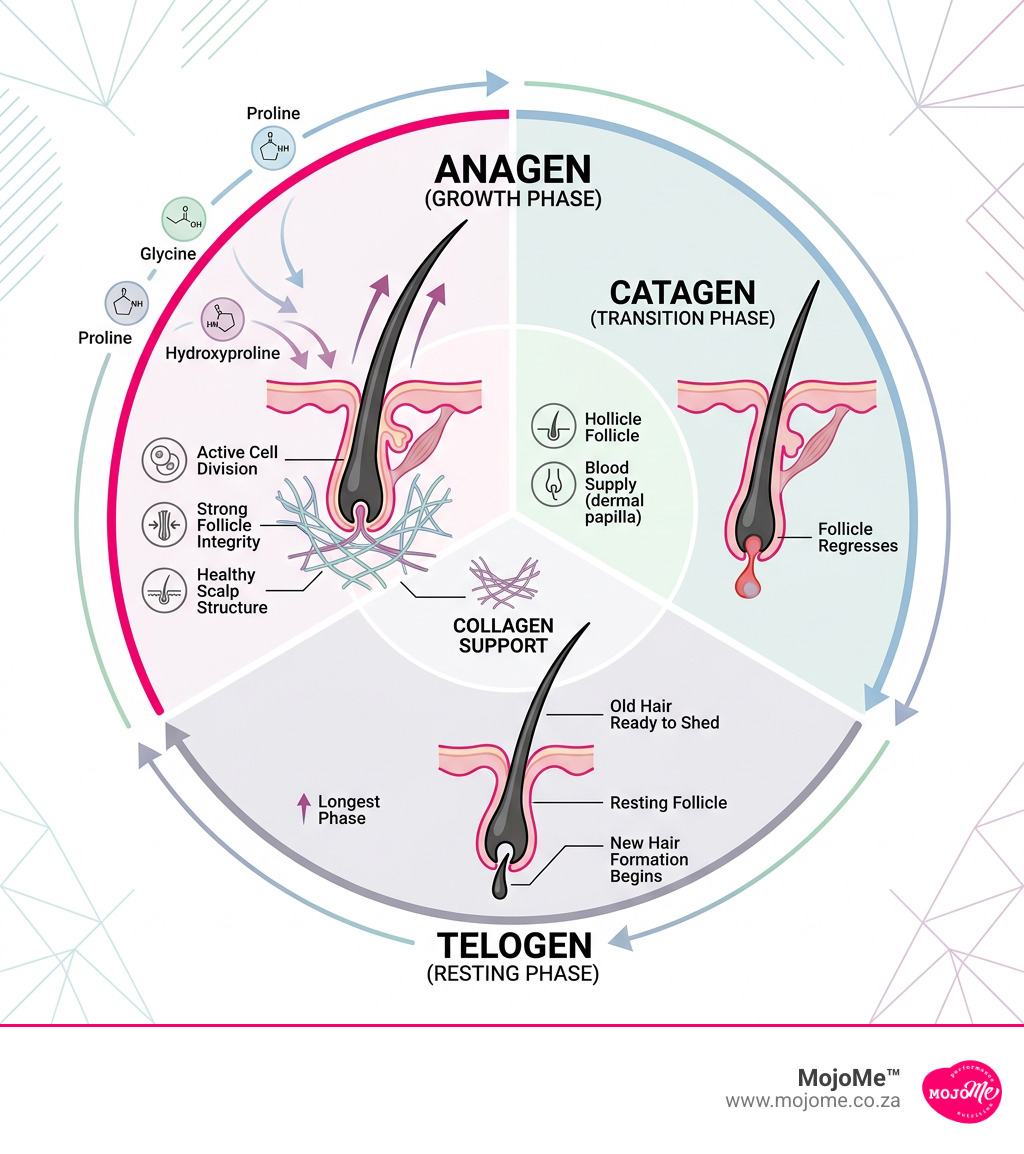
But how does a protein found in your joints help the hair on your head? It comes down to the building blocks. Collagen is rich in amino acids, specifically proline, glycine, and hydroxyproline. Proline is a major component of keratin production. Since your hair is primarily made of keratin, providing your body with the raw materials it needs is essential for maintaining hair strength and structure.
Furthermore, collagen is vital for the dermis—the middle layer of your skin that contains the roots of each individual hair. As we age and our natural collagen production dips (decreasing by 1% to 1.5% every year after early adulthood), this layer can become less elastic and more brittle. A healthy, supple scalp provides a better “anchor” for hair follicles. By supporting The Building Blocks for Healthy Hair, collagen helps maintain the environment where hair is born.
The Science Behind Taking Collagen for Hair Loss
Is there hard evidence for taking collagen for hair loss? While we are still waiting for massive, independent human clinical trials, recent research has provided some exciting insights.
An Ex vivo study on hair follicles published in 2024 found that collagen peptides can actually prolong the “anagen” or growth phase of the hair cycle. By keeping the hair in the growth phase longer, you naturally experience less shedding. The study also suggested that collagen helps maintain the “quiescence” (a healthy state of rest) of hair follicle stem cells, which are crucial for regenerating new hair.
Another angle involves UV protection and free radical damage. Free radicals are unstable molecules produced by pollution, smoking, and sun exposure. These molecules can damage the DNA in your hair follicles, leading to thinning or premature graying. Research shows that collagen—particularly marine collagen—acts as an antioxidant to fight this oxidative stress. By boosting antioxidant activity, collagen may protect the scalp from the environmental factors that accelerate hair aging.
Finally, we cannot ignore the importance of scalp health. A 2019 meta-analysis on the dermatological applications of collagen confirmed that oral collagen supplements significantly improve skin elasticity and hydration. A hydrated scalp is a healthy scalp, and a healthy scalp is the foundation of a thick mane.
Benefits of Taking Collagen for Hair Loss Prevention
When we talk about “hair loss,” we are often talking about several different issues. Collagen may offer unique benefits for each:
- Age-Related Thinning: As our dermal thickness decreases with age, hair follicles can miniaturize. Collagen helps maintain that dermal density.
- Shedding Reduction: By prolonging the anagen phase and delaying the telogen (shedding) phase, collagen may help reduce the excessive shedding often seen in temporary conditions.
- Telogen Effluvium: This is a type of temporary hair loss caused by stress or nutritional deficiencies. Collagen provides the amino acids necessary to jumpstart the recovery process.
- Follicle Support: It acts like a “tent stake,” providing the structural integrity needed to keep the hair firmly rooted in the scalp.
For a deeper dive into these mechanisms, check out our Ultimate Guide to Collagen for Hair Growth.
Comparing Collagen to Proven Medical Treatments
It is important to manage expectations. If you are dealing with genetic male pattern baldness (androgenetic alopecia), taking collagen for hair loss is likely not enough on its own.
Genetic hair loss is largely driven by DHT (dihydrotestosterone), a hormone that shrinks hair follicles. Proven medical treatments like Minoxidil (which increases blood flow to follicles) and Finasteride (which blocks DHT) work on different biological pathways than collagen does.
In a Saw palmetto trial, researchers found that while natural alternatives like saw palmetto helped 38% of patients, medical treatments like finasteride were significantly more effective (68%).
We view collagen as an adjuvant therapy. It doesn’t block DHT, but it ensures that the “soil” (your scalp) is as nutrient-rich and healthy as possible while you use other treatments to tackle the “pests” (hormones).
Choosing the Best Type of Collagen for Your Strands
Not all collagen is created equal. When you’re looking at supplements, you’ll likely see two main sources: Bovine (cow) and Marine (fish).
Comparing Marine vs. Bovine Collagen
| Feature | Marine Collagen | Bovine Collagen |
|---|---|---|
| Source | Fish scales and skin | Cow hides and bones |
| Collagen Types | Primarily Type I | Types I and III |
| Absorption | Up to 1.5x more efficient | Standard absorption |
| Best For | Hair, skin, and nails | Joints, gut, and muscle |
| Bioavailability | High (smaller peptides) | Moderate |
For hair specific concerns, many experts lean toward hydrolyzed peptides. “Hydrolyzed” simply means the protein has been broken down into smaller chains that are much easier for your body to absorb. This bioavailability is key because if the molecules are too large, they simply pass through your system without being utilized. You can learn more about these nuances in our guide to Collagen Types and Differences.
Marine Collagen for Hair Thickness and Strength
Marine collagen is often considered the “beauty” collagen. Because it is extracted from fish scales, it consists of smaller particles that provide superior skin elasticity benefits. When it comes to hair, the smaller peptide size means your body can quickly shuttle those amino acids to the hair follicles. As we say at MojoMe™, when it comes to collagen, you should Discover Why Size Matters.
Dietary Sources and Collagen-Boosting Nutrients
While supplements are convenient, you can also support your collagen levels through your diet.
- Bone Broth: This is a classic source. Gelatin benefits come from simmering animal bones, which releases collagen into a bioavailable liquid form.
- Vitamin C: This is the most important co-factor. Your body cannot produce collagen without it. Oranges, strawberries, and bell peppers are essential for a natural production boost.
- Zinc and Copper: These minerals act as “activators” for collagen synthesis.
- Animal Proteins: Chicken skin and fish are naturally high in the amino acids needed for collagen.
If you find it difficult to consume enough bone broth or organ meats, a high-quality Pure Collagen Powder can bridge the gap.
How to Optimize Your Results When Taking Collagen for Hair Loss
If you decide to start taking collagen for hair loss, consistency is your best friend. You can’t take one scoop and expect a Rapunzel-like transformation overnight.
We recommend a daily dose of 10 to 15 grams of hydrolyzed collagen. Because most high-quality powders are flavorless, they are Easy to Add to Your Routine. You can stir it into your morning coffee, blend it into a smoothie, or even mix it into a bowl of yogurt.
Safety and Tolerance
According to the safety profile of collagen, it is generally considered safe for most people. Some users might experience mild GI tolerance issues like bloating or a lingering aftertaste, but these are rare with high-purity, filler-free products like ours.
Recommended Dosage and Expected Timeline
Hair grows slowly—usually about half an inch (1.25 cm) per month. Because of this, you need to be patient.
- Weeks 1-4: You might notice improved skin hydration and stronger nails first.
- Months 2-3: You may see a reduction in daily shedding.
- Months 4-6: This is the “sweet spot” where you might notice increased hair thickness or better overall volume.
The effects are cumulative. Long-term maintenance is required to keep the benefits, especially as natural production continues to decline with age.
Frequently Asked Questions about Collagen and Hair
Can collagen help with male pattern baldness?
Collagen can improve the quality of the hair you have and support the health of the scalp, but it does not address the hormonal cause of male pattern baldness (DHT). It is best used as a supportive supplement alongside other treatments.
How long does it take to see results from collagen?
Most people need to take collagen consistently for 3 to 6 months before they notice a visible difference in hair thickness or growth.
Are there any side effects of collagen supplements?
Collagen is very well-tolerated. The most common “side effects” are actually just digestive—some people feel a bit full or bloated if they take too much at once. Choosing a hydrolyzed version helps minimize this.
Conclusion
At MojoMe™, we believe in a holistic approach to wellness. Taking collagen for hair loss isn’t a “magic pill,” but it is a science-backed way to provide your body with the essential nutrients it needs to maintain a healthy scalp and strong strands.
By combining a clean, filler-free collagen supplement with a nutrient-dense diet and proper hair care, you are giving your mane the best possible defense against the aging process. Whether you’re looking for the Top 10 Benefits of Collagen or specifically targeting your hair health, we are here to support your journey with award-winning, science-backed nutrition from Cape Town.
Ready to start your journey? Shop Collagen Powder today and give your hair the protein foundation it deserves.