What Is the Collagen Type 1 2 3 Difference? (Quick Answer)
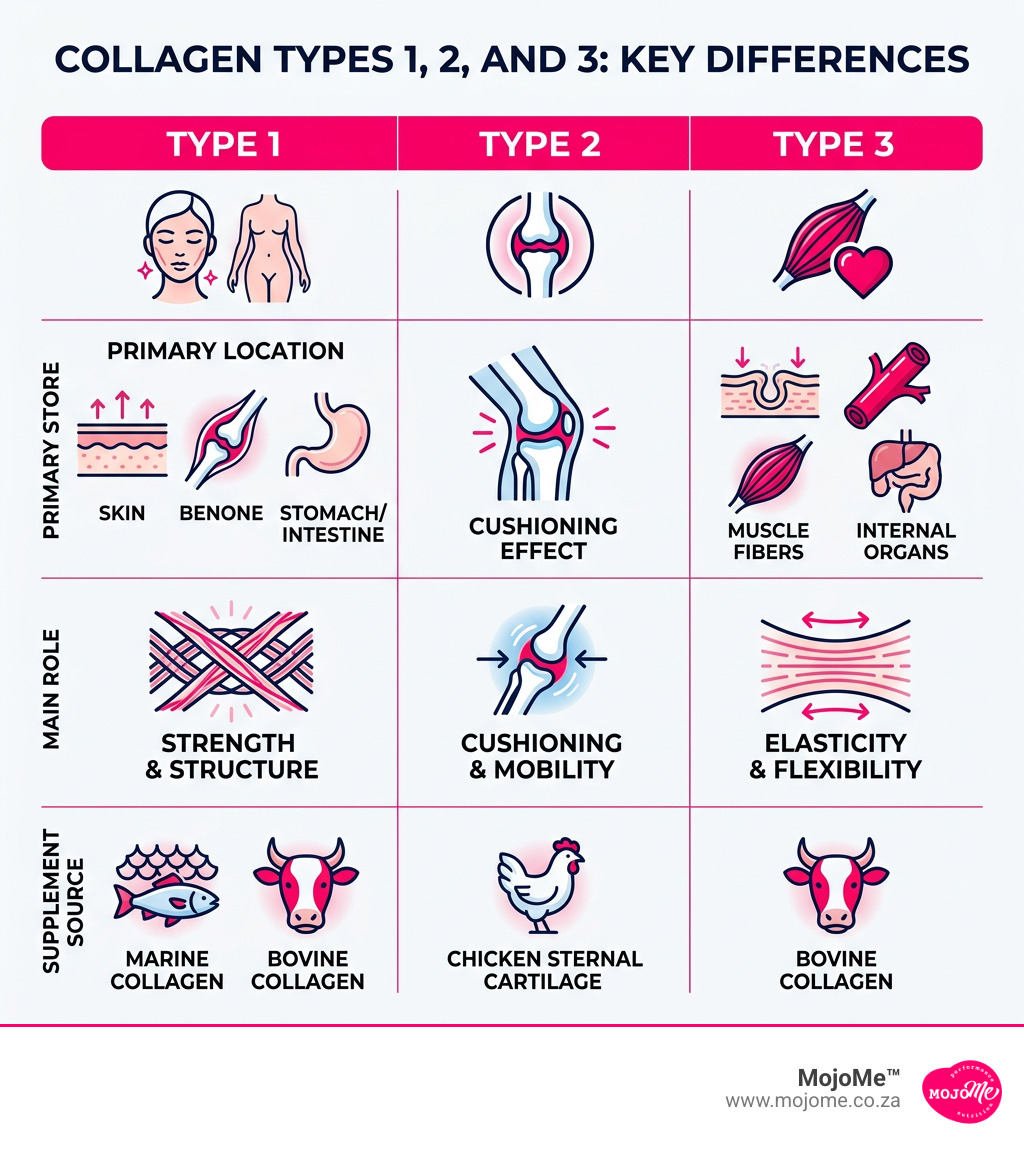
The collagen type 1 2 3 difference comes down to where each type is found in the body and what it does:
| Collagen Type | Primary Location | Main Role |
|---|---|---|
| Type 1 | Skin, bones, tendons, gut lining | Strength and structure |
| Type 2 | Cartilage, joints | Cushioning and mobility |
| Type 3 | Skin, blood vessels, muscles, organs | Elasticity and flexibility |
Together, types 1, 2 and 3 make up 80 to 90% of all the collagen in your body.
Walk into any health store and you will find shelves lined with collagen products. Bovine. Marine. Hydrolysed peptides. Multi-collagen blends. The options are overwhelming, and most labels do not make it easy to understand what you are actually buying.
Here is the problem: not all collagen types do the same thing. Taking the wrong type for your goal is like using a bandage when you need a splint. It is not harmful, but it is not helping either.
Collagen is the most abundant protein in the human body, making up roughly 30% of your body’s total protein. It acts as the structural scaffolding that holds your skin firm, keeps your joints cushioned and supports your gut lining. But the collagen that holds your knee cartilage together is structurally different from the collagen keeping your skin supple.
Understanding which type does what is the first step to choosing a supplement that actually supports your health goals.
Defining the Collagen Type 1 2 3 Difference
To understand the collagen type 1 2 3 difference, we have to look at the biology of the protein itself. At its most basic level, collagen is a long-chain amino acid made up of individual proteins. These proteins are primarily glycine, proline and hydroxyproline.
In the body, these amino acids wrap around each other to form a triple helix. Imagine three strands of rope twisted tightly together. This structure is what gives collagen its incredible tensile strength. Some types of collagen are stronger than steel when compared gram for gram.
While there are at least 28 different types of collagen identified by scientists, the vast majority of our body is composed of just three. According to Scientific research on collagen types, roughly 80 to 90% of the collagen in your body consists of types 1, 2 and 3.
Type 1 is the heavyweight of the group, accounting for approximately 90% of your body’s total collagen. It is found in your skin, hair, nails, organs, bones and ligaments. Type 2 is almost exclusively found in your cartilage, while Type 3 is often found alongside Type 1, providing the “stretch” to your skin and blood vessels.
The main collagen type 1 2 3 difference lies in how these triple helices are packed together. Type 1 fibres are packed very tightly, making them ideal for providing structure and resisting stretching. Type 2 fibres are more loosely packed and mesh-like, which allows them to trap water and provide the shock absorption needed in your joints.
Type 1 and 3: The Foundation of Skin and Gut Health
When people talk about the “beauty” benefits of collagen, they are usually referring to types 1 and 3. These two types are the primary residents of your dermal layer, which is the thick layer of skin just beneath the surface.
Type 1 collagen provides the strength and structure that keeps skin from sagging. It is also a major component of your bones. In fact, about 36% of your bone mass is made of collagen, specifically types 1 and 3. Without it, your bones would be brittle and prone to breaking.
Type 3 collagen is the “elastic” partner. It is the second most abundant type in the body and is essential for the integrity of hollow structures like your blood vessels, lungs and intestinal tract. Research suggests that Type 1 collagen is the most abundant in the human body. You can find type 1 collagen in your eyes, skin, tendons, bone, and teeth. Even though it’s great for rebuilding yourmuscles, eyes, bones, and spine, it’s famous forminimizing fine lines and wrinklesand improving skin elasticity and hydration. …
One of the most important roles for types 1 and 3 is in gut health. The lining of your digestive tract is made of millions of tiny cells held together by a “glue” of collagen. If this lining becomes weak, it can lead to what is commonly called “leaky gut,” where undigested food particles and toxins enter the bloodstream. Supplementing with these types helps to strengthen the tight junctions of your intestinal tract, supporting overall digestive wellness.
How the Collagen Type 1 2 3 Difference Affects Skin
As we age, our natural production of collagen begins to drop. For most South Africans, this decline starts in our mid-20s, decreasing by about 1 to 1.5% every year. By the time we reach 40, our collagen levels have dropped significantly, leading to visible fine lines and wrinkles.
The collagen type 1 2 3 difference becomes very apparent here. Type 3 collagen actually decreases more drastically in the skin as we age than Type 1 does. This loss of Type 3 is a major contributing factor to skin ageing, including loss of elasticity and the development of deeper wrinkles. You can read more about this in this Study on type 3 collagen and ageing.
To combat this, many people turn to supplements. There are two main sources for types 1 and 3:
- Bovine Collagen: Sourced from the hides of cows. It is naturally rich in types 1 and 3. Because it closely mimics the collagen found in the human body, it is highly effective for skin, hair and gut support.
- Marine Collagen: Sourced from fish scales and skin. It is almost exclusively Type 1 collagen. Because marine collagen has smaller particle sizes, some find it absorbs slightly faster, making it a popular choice for targeted beauty goals.
According to this Research on type 1 collagen for skin, participants who took a daily supplement of hydrolysed Type 1 collagen reported significant improvements in skin hydration and a reduction in the depth of wrinkles after just 60 days.
For a deeper dive into which source is right for you, check out our guide on marine vs bovine collagen.
Type 2 Collagen: The Essential Component for Joint Mobility
If your goal is to move without pain or support your athletic recovery, Type 2 collagen is your best friend. Unlike types 1 and 3, which are spread throughout the body, Type 2 is highly specialised.
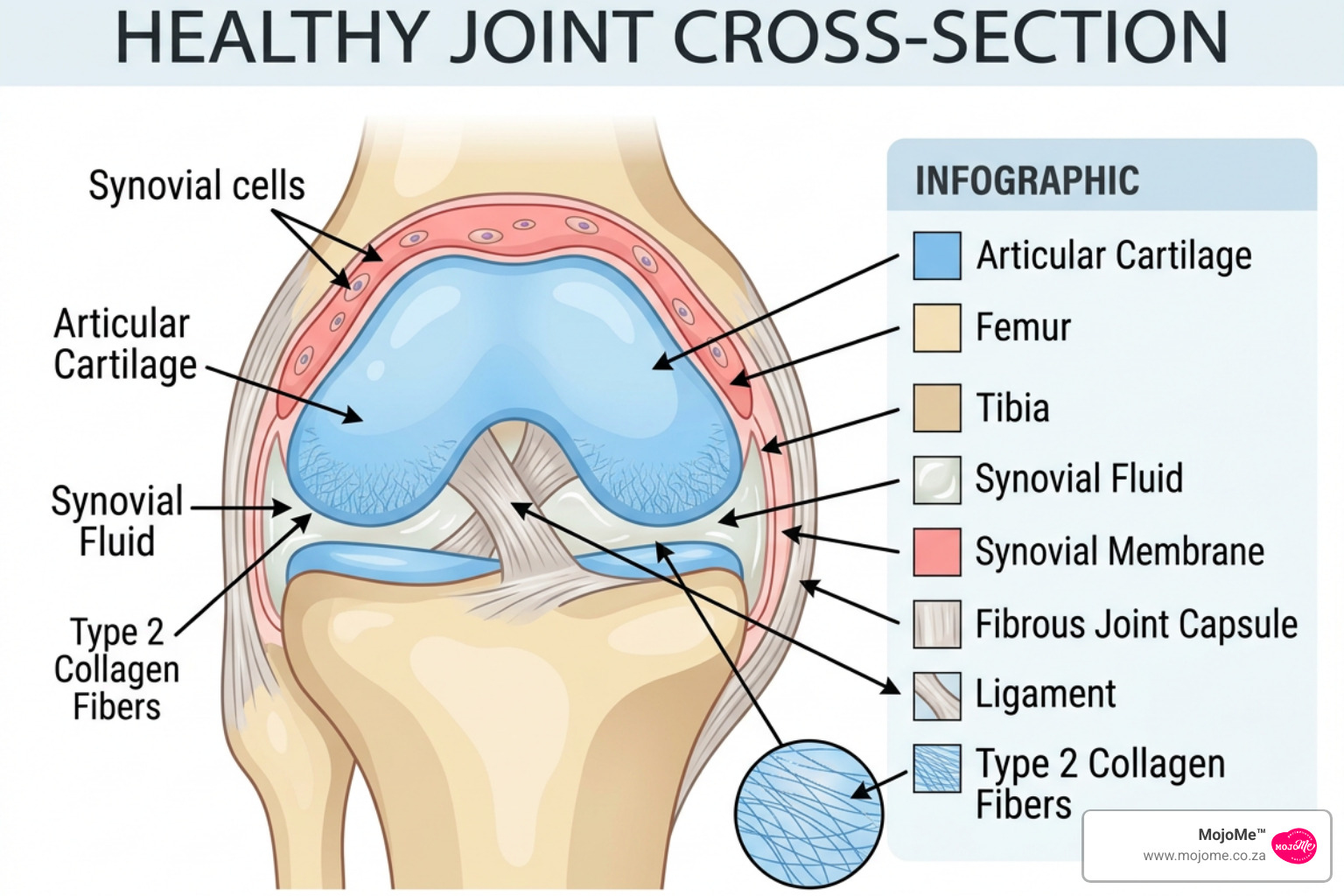
It makes up about 50% of all the protein in your cartilage and a staggering 85 to 90% of the collagen in your articular cartilage. This is the slippery, flexible tissue that covers the ends of your bones where they meet to form a joint. It acts as a shock absorber, allowing your joints to glide smoothly.
The collagen type 1 2 3 difference here is functional. While Type 1 is designed to resist being pulled (tensile strength), Type 2 is designed to resist being squashed (compressive strength). It forms a mesh-like structure that holds proteoglycans, which are molecules that attract and hold water. This keeps your joints lubricated and bouncy.
Research has shown that Type 2 collagen is particularly effective for those dealing with joint wear and tear. A 2016 study published in the Nutrition Journal found that individuals taking a Type 2 supplement for 180 days saw marked improvements in physical function and a reduction in joint pain and stiffness.
Understanding the Collagen Type 1 2 3 Difference for Joint Support
Many active South Africans suffer from activity-related joint pain. Whether it is from running on the Sea Point promenade or heavy lifting in the gym, the repetitive impact can cause the cartilage to thin over time.
Because Type 2 collagen is so different in structure from types 1 and 3, it is often sourced differently. Most Type 2 supplements come from chicken sternum cartilage. This source is naturally rich in the specific amino acids and molecules like chondroitin and glucosamine that joints need to repair.
We discuss the specific role of this joint protector in our article unraveling the mystery: what does collagen type 2 do?.
It is important to note that Type 2 collagen is sometimes harder for the body to absorb in high amounts if it is not prepared correctly. This is why we often recommend specific type 2 collagen capsules or chicken collagen to ensure you are getting a concentrated dose targeted directly at your joints. You can learn more about these absorption problems on our blog.
Sourcing and Supplementing for Optimal Health
Knowing the collagen type 1 2 3 difference is only half the battle. You also need to know how to get these proteins into your system effectively.
The gold standard for supplementation is hydrolysed collagen peptides. In its raw state, the collagen molecule is too large for your body to absorb. Through a process called hydrolysis, these large molecules are broken down into tiny peptides with a low molecular weight. These are much easier for your gut to process and send to the parts of your body that need them most.
In collagen, size really does matter. Smaller peptides mean better bioavailability. We explain this further in our collagen 101: discover why size matters guide.
The Role of Vitamin C and Lifestyle
Your body cannot build collagen alone. It requires specific cofactors to turn those amino acids into the triple helix structure. The most important of these is Vitamin C. Without enough Vitamin C, the enzymes that “glue” the collagen strands together cannot function. This is why we recommend taking your collagen with at least 500 milligrams of Vitamin C daily.
Lifestyle factors also play a massive role in how much collagen you keep. In South Africa, our beautiful sun is a double-edged sword. UV exposure is one of the fastest ways to damage existing collagen fibres. Other “collagen killers” include:
- High Sugar Intake: Sugar attaches to proteins in your blood, creating molecules called AGEs (Advanced Glycation End-products) that make collagen brittle.
- Smoking: Reduces the amount of oxygen reaching your skin and directly inhibits collagen synthesis.
- Ageing: Production naturally slows down as we get older, particularly after menopause.
Can I take types 1, 2 and 3 together?
A common question we hear at MojoMe is whether you can mix these types. The answer is a resounding yes. In fact, taking them together can have a synergistic effect.
Bovine collagen naturally provides a mix of types 1 and 3. When you add a Type 2 source, you are essentially giving your body a full toolkit to repair everything from your skin to your spine. This is the logic behind a “multi-collagen” approach.
However, some experts suggest that if you have a very specific goal, like severe joint pain, you might want to take your Type 2 supplement at a different time of day (like at bedtime on an empty stomach) to prevent the amino acids from competing for absorption. For general wellness, a blend is perfectly fine and highly convenient. You can find more about these important differences on our education page.
Which type is best for hair and nails?
If you are looking for longer hair and stronger nails, focus on Type 1. Hair and nails are primarily made of keratin, and the body uses the amino acids found in Type 1 collagen (proline in particular) to build that keratin.
Many of our customers in Cape Town find that daily supplementation helps with brittle nails and hair thinning. Because Type 1 is the most abundant, a standard 10 gram serving of bovine or marine collagen is usually sufficient to see results in these areas.
How long does it take to see results?
Patience is key when it comes to collagen. While some people report better skin hydration within a few weeks, most clinical studies show that significant changes take about 12 weeks of consistent daily use.
This timeline aligns with the natural turnover of our cells. Your skin cells take about 27 to 30 days to renew, while your connective tissues and joints take longer. If you stay consistent for three months, you are giving your body enough time to incorporate those new building blocks into its structures.
For more foundational information, our collagen 101 guide is a great place to start.
Conclusion
The collagen type 1 2 3 difference is more than just a scientific curiosity. It is a practical guide to help you spend your money wisely and get the results you want. Whether you are looking to firm up your skin with Type 1, support your joints with Type 2 or improve your gut health with Type 3, there is a specific solution for you.
At MojoMe, we believe in the power of purity. Based in Muizenberg, Cape Town, we produce 100% natural, science-backed supplements that contain no fillers, sugars or hidden nasties. Our award-winning range is designed to help you age gracefully and move freely.
Do not leave your health to guesswork. By choosing high-quality, hydrolysed peptides and matching the collagen type to your specific goal, you are investing in a stronger, more resilient version of yourself.
If you want to stay updated on the latest health insights and premium wellness tips tailored for the South African market, Sign up for health updates. We are here to support your journey every step of the way.