The Collagen You Pick Could Make or Break Your Results
Which collagen is best bovine or marine is one of the most searched supplement questions right now — and for good reason. The wrong choice won’t hurt you, but the right one could meaningfully change your skin, joints, or recovery.
Here’s the short answer:
| Goal | Best Choice |
|---|---|
| Skin, hair, and nails | Marine collagen (Type I, higher absorption) |
| Joint, gut, and muscle support | Bovine collagen (Type I + III, broader tissue coverage) |
| Anti-aging and bioavailability | Marine collagen (smaller peptides, ~90% absorption rate) |
| Budget-friendly, versatile use | Bovine collagen (more affordable, wider availability) |
| Both skin and joints | Combine both for full-spectrum support |
Neither is universally “better.” It depends on your body and your goals.
Here’s what we know: collagen makes up roughly 30% of all protein in the human body. It holds your skin firm, cushions your joints, and supports your gut lining. But starting around age 25, your body begins producing less of it every year — roughly 1.5% less annually.
That’s where supplements come in. But marine and bovine collagen are not the same product. They come from different sources, contain different collagen types, and work best for different needs.
This guide breaks it all down so you can choose with confidence.
Which Collagen Is Best Bovine or Marine: A Side-by-Side Comparison
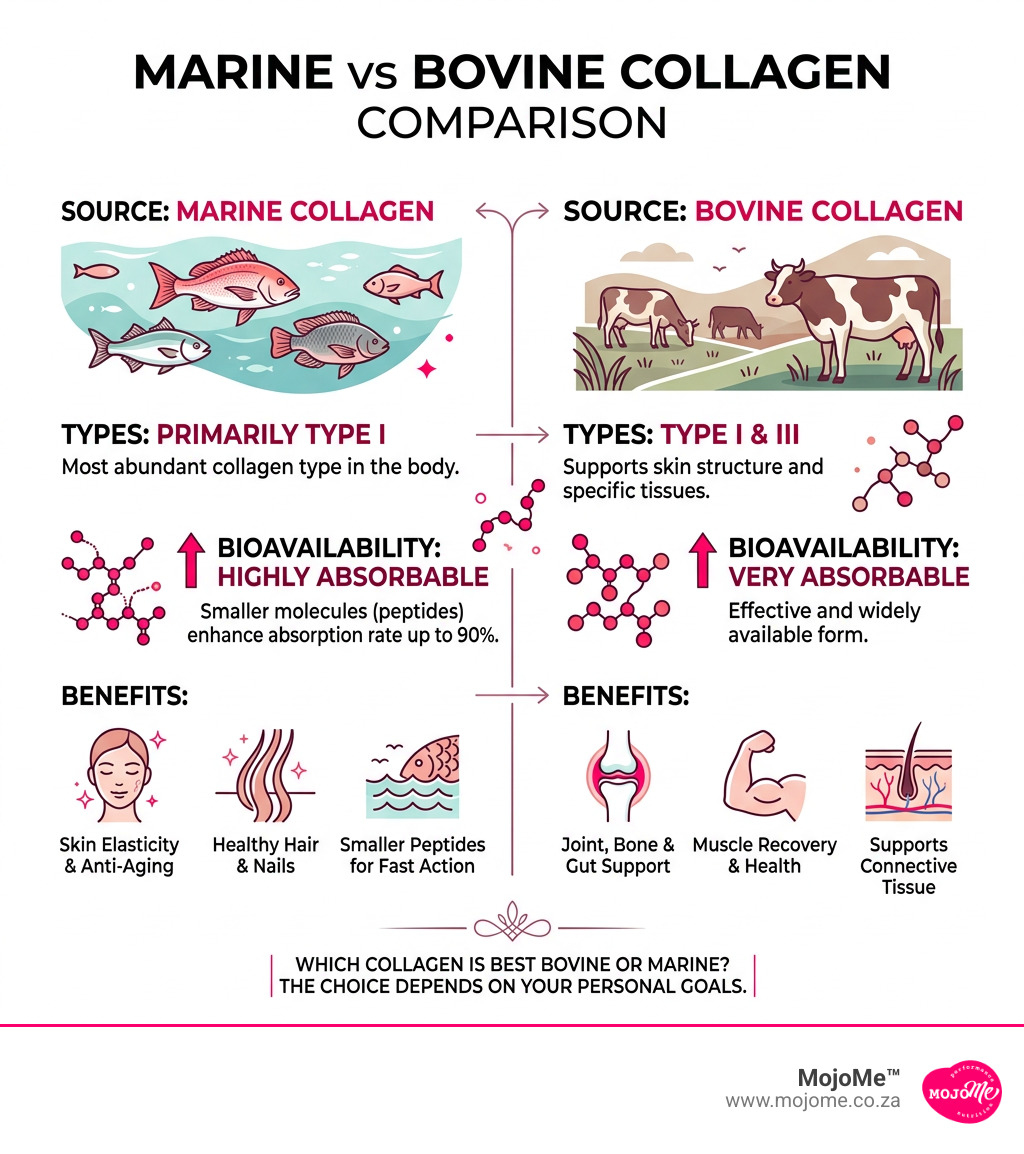
When we look at the battle of the proteins, the first thing to understand is where they come from. Bovine collagen is derived from cow hides (and sometimes bones or cartilage), while marine collagen is sourced from fish skin, scales, and bones.
The primary difference lies in their “collagen profile.” While there are at least 28 known types of collagen in the human body, Types I, II, and III do about 90% of the heavy lifting. Bovine collagen is a powerhouse of Type I and Type III. Marine collagen, on the other hand, is almost exclusively Type I.
Why does this matter? Type I is the most abundant form in our bodies, acting as the structural building block for skin, tendons, and bones. Type III is found in our muscles, organs, and blood vessels. Because marine collagen is so concentrated in Type I, it is often seen as the “beauty” collagen. Bovine, offering both I and III, is seen as the “all-rounder.”
Scientific reviews suggest that marine sources are significantly more advantageous for specific tasks like wound healing and skin anti-aging. However, when deciding which collagen is best bovine or marine, you have to look at the amino acid concentration. Both are rich in glycine, proline, and hydroxyproline, but their ratios and molecular weights differ, influencing how your body puts them to work.
Why marine collagen is best bovine or marine for anti-aging
If your primary goal is to turn back the clock on your skin, marine collagen is usually the winner. This is because marine collagen specifically targets fibroblasts—the “engine room” cells in your dermis responsible for churning out new collagen and elastin.
As we age, these fibroblasts become a bit sluggish. Marine collagen provides the specific Type I peptides that act as a biological “wake-up call.” Research into the dermatological applications of oral collagen shows that consistent supplementation can lead to visible reductions in wrinkle depth and significant improvements in skin elasticity and hydration.
At MojoMe™, we’ve seen how the benefits of marine collagen extend beyond just a glowy complexion. Because it mirrors the collagen already in your skin so closely, the body can “plug and play” these nutrients much faster than land-based sources.
Choosing bovine collagen when it is best bovine or marine for recovery
If you’re an athlete, a gym-goer, or someone struggling with joint stiffness, bovine collagen might be your best friend. Because it contains Type III collagen, it is particularly effective at supporting muscle mass and repairing the connective tissues that take a beating during exercise.
A study on body composition and recovery found that collagen peptide supplementation, when combined with resistance training, helped increase muscle strength and fat-free mass, particularly in those dealing with age-related muscle loss (sarcopenia).
For those of us in Cape Town living active lifestyles—whether hiking Table Mountain or surfing at Muizenberg—joint health is non-negotiable. Bovine collagen helps maintain the integrity of the cartilage that cushions your joints. If you find powders inconvenient, grass-fed collagen capsules offer a quick way to get these recovery nutrients into your system without the mess.
Marine Collagen: The Gold Standard for Bioavailability and Skin

Bioavailability is a fancy word for “how much of this actually makes it into my bloodstream?” In this category, marine collagen is the undisputed heavyweight champion.
The secret lies in the molecular size. Collagen in its “native” state is a massive, complex protein that your body can’t absorb easily. To make it useful, it must be “hydrolyzed”—broken down into tiny chains called peptides.
Superior absorption and peptide size
Marine collagen naturally has a smaller molecular weight (measured in Daltons) than bovine collagen. When combined with enzymatic hydrolysis, these peptides become so small that they boast a 90% absorption rate. This means they pass through the intestinal wall and into the bloodstream with incredible efficiency.
When comparing marine collagen vs factory farmed fish, quality matters. Farmed fish can be exposed to hormones and antibiotics, which is why we strictly advocate for wild-caught sources. Whether you prefer marine collagen capsules or powder, the goal is to get those low-Dalton peptides working for your skin and hair as quickly as possible.
Ethical sourcing and sustainability
Many people ask which collagen is best bovine or marine from an environmental perspective. Marine collagen is often considered the more sustainable choice because it utilizes parts of the fish—like scales and skin—that would otherwise be discarded by the fishing industry.
By using these “by-products,” we reduce waste. However, the “wild-caught” label is crucial here. Choosing wild-caught marine collagen ensures that you aren’t supporting the environmental issues often associated with large-scale fish farming, such as water pollution and the spread of sea lice.
Bovine Collagen: The Powerhouse for Joints, Gut, and Muscle
While marine collagen wins on absorption speed, bovine collagen wins on versatility and price. It is a robust source of the amino acids glycine and proline, which are essential for building healthy cartilage and bone matrix.
Research on collagen for joint pain has shown that regular intake can significantly reduce activity-related joint pain in athletes and improve mobility in people with osteoarthritis. When you’re looking for how to choose the best collagen, always look for “grass-fed” and “pasture-raised” to ensure the highest nutrient density.
Gut health and intestinal barrier repair
One of the most exciting benefits of bovine collagen is its impact on the gut. It contains high levels of glutamine, an amino acid that plays a vital role in the health of the intestinal lining.
If you struggle with “leaky gut” or general digestive inflammation, bovine collagen helps “seal and heal” the protective lining of the gastrointestinal tract. This is a huge win for overall immunity, as a large portion of your immune system resides in your gut. For those following a keto diet, bovine collagen is an excellent way to maintain protein levels without adding carbs or sugars.
Broader tissue support with Type I and III
Because bovine collagen provides Type III, it offers broader support for the “hidden” parts of your body. Type III is a major component of our arteries and organs. A scientific review of Type I collagen notes that while Type I is essential for bone mineral density, having that Type III support ensures that your blood vessels and muscles remain elastic and resilient.
Key Differences in Cost, Taste, and Lifestyle Fit
Let’s get practical. You can buy the best supplement in the world, but if it tastes like a swamp or breaks the bank, you won’t take it.
Managing allergies and sensitivities
This is the biggest “dealbreaker” in the which collagen is best bovine or marine debate. If you have a fish or shellfish allergy, marine collagen is off the table. Conversely, if you avoid beef for religious or dietary reasons, marine is your go-to.
Taste is another factor. High-quality marine collagen should be virtually tasteless, but lower-quality versions can have a lingering “ocean” flavor. If you find that marine collagen tastes fishy, it’s usually a sign of poor processing or oxidation. Bovine collagen tends to have a more neutral, creamy profile that disappears perfectly into coffee or smoothies. If you have trouble with clumping, we have some tips on solving collagen dissolution problems to keep your morning brew smooth.
Price accessibility and daily dosage
Bovine collagen is generally more affordable than marine collagen. This is simply due to the scale of the beef industry compared to specialized wild-caught fishing.
When it comes to daily dosage recommendations, most studies suggest:
- Skin and hair: 5–10g per day.
- Joints and muscle recovery: 10–20g per day.
Because bovine is cheaper, it’s often easier to hit those higher 20g doses for joint health without hurting your wallet.
Frequently Asked Questions about Marine and Bovine Collagen
Can you take both marine and bovine collagen together?
Absolutely! In fact, many people find this to be the “sweet spot.” By combining them, you get the rapid absorption and Type I focus of marine collagen for your skin, plus the Type III and gut-healing benefits of bovine collagen. Just aim for a total daily intake of 10-20g.
How long does it take to see results from collagen?
Patience is key. While some people notice “glowier” skin in as little as 4 weeks, joint and gut improvements typically take 8 to 12 weeks of consistent daily use. Collagen is a “slow and steady” supplement, not an overnight fix.
Is marine collagen better for hair growth than bovine?
Recent research suggests marine collagen might have a slight edge here. It contains higher levels of the amino acid hydroxyproline, and some studies indicate it may help prolong the “anagen” (growth) phase of the hair follicle. However, both will provide the amino acids (like proline) that your body uses to build keratin, the primary protein in hair.
Conclusion: Making the Right Choice for Your Health Goals
So, which collagen is best bovine or marine?
If you want the absolute best for your skin, hair, and nails and don’t mind spending a little extra for superior absorption, go with Marine.
If you want to support your joints, heal your gut, and recover from workouts—all while staying on a budget—go with Bovine.
At MojoMe™, we don’t believe in fillers, sugars, or “fluff.” Based in beautiful Cape Town, we produce pure, science-backed supplements designed to actually work. Whether you choose our pure marine collagen powder or our grass-fed bovine options, you’re getting 100% natural nutrition with no hidden nasties.
Ready to start your journey? Shop the full MojoMe collagen range and give your body the structural support it deserves.