Understanding the Biological Role of Collagen in Skin Health
#
Collagen for anti aging is one of the most searched wellness topics right now — and for good reason. Here’s a quick answer before we dive deeper:
What the evidence shows:
- Collagen supplements can improve skin hydration and elasticity — multiple studies confirm this
- Wrinkle reduction is real but modest — don’t expect dramatic overnight changes
- Results take time — most people see noticeable changes between 4 and 12 weeks of consistent use
- Not all studies agree — independent (non-industry-funded) research shows weaker effects than brand-sponsored studies
- Oral (internal) collagen works better than topical — collagen molecules are too large to absorb through skin
- The best results come from combining supplements with lifestyle habits — SPF, diet, and sleep all matter
Think of collagen as the scaffolding inside your skin. It keeps everything firm, plump, and resilient. When you’re young, your body makes plenty of it. But from your mid-20s onward, production starts to slow — about 1% to 1.5% every year.
By the time menopause arrives, women can lose roughly a third of their skin’s collagen. That’s when wrinkles deepen, skin loses its bounce, and that youthful glow starts to fade faster.
The supplement industry has noticed. The global collagen market doubled between 2019 and 2022, and it’s still growing. But with so many products making bold promises, it’s worth asking: what does the science actually say?
This guide cuts through the noise. We look at the real research — including a 2025 meta-analysis of 23 randomized controlled trials — to help you make an informed decision.
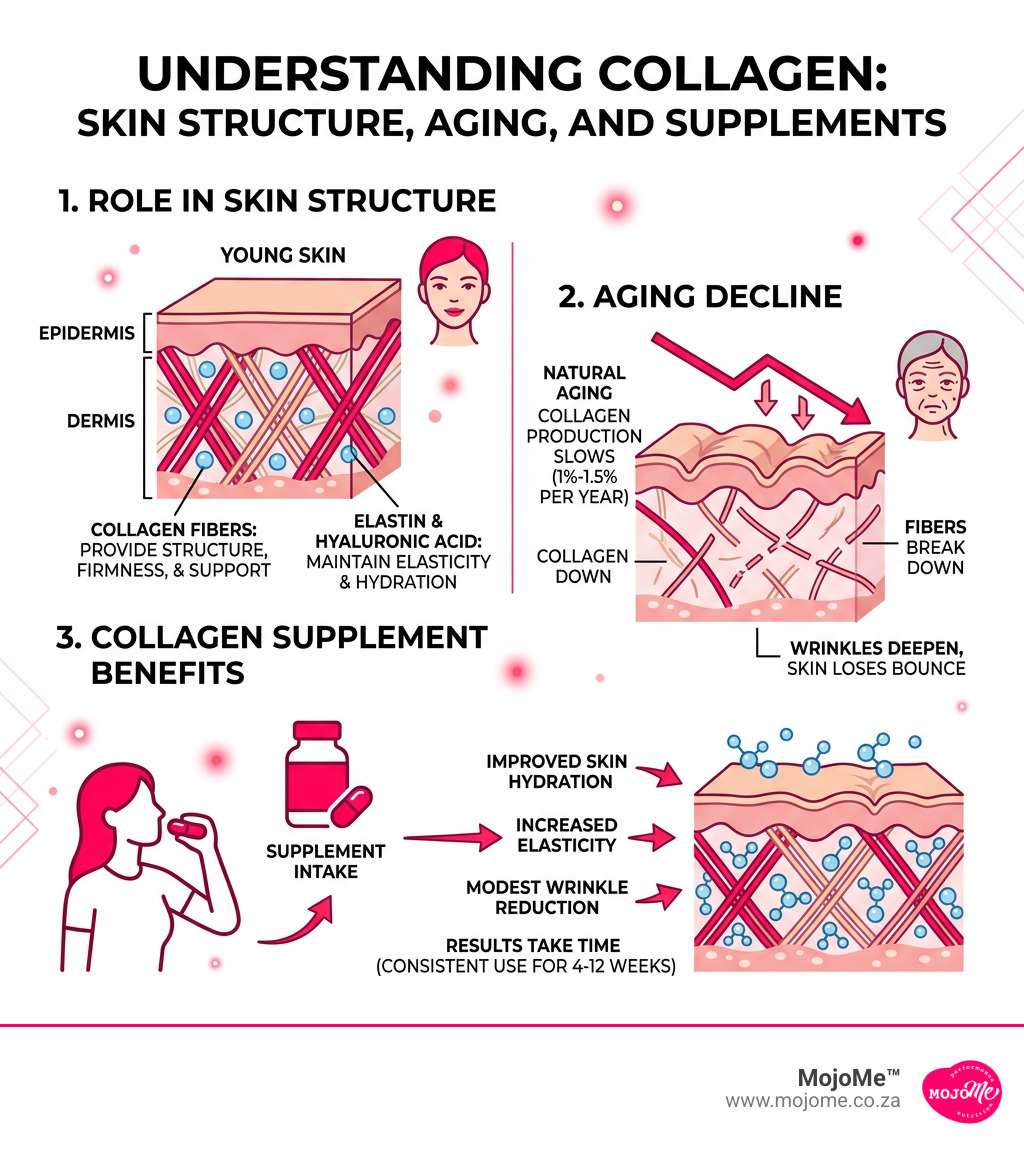
To understand why we’re all so obsessed with collagen for anti aging, we first need to look at what it actually does. Collagen isn’t just a beauty buzzword; it’s the most abundant protein in the human body, making up at least 30% of our total protein mass. In the skin, its role is even more dominant, accounting for over 90% of the skin’s dry weight.
Think of your skin as a high-end mattress. The springs provide the lift and structure — that’s your collagen. The padding provides the softness — that’s the hyaluronic acid and elastin. When the springs start to snap or sag, the mattress loses its shape. This is exactly what happens to our skin’s mechanical integrity as we age.
Collagen is produced by specialized cells called fibroblasts. These little “beauty factories” sit in the dermis (the deeper layer of your skin) and churn out collagen fibers that form a dense, organized extracellular matrix. This matrix is what gives young skin its incredible “snap-back” ability.
However, it’s not just about skin. Collagen provides the building blocks for healthy skin, hair, and joints, acting as the literal glue that holds our bones, tendons, and organs together. According to scientific research on skin aging biology, the breakdown of this structural network is the primary driver of visible aging.
How Aging and Menopause Accelerate Collagen Loss
If aging is a slow walk down a hill, menopause can sometimes feel like a cliff-dive for skin health. While we naturally lose about 1% to 1.5% of our collagen every year starting in our mid-20s, the hormonal shifts during menopause cause a dramatic acceleration.
Research indicates that skin loses about one-third of its collagen during the first few years of menopause. This is largely due to declining estrogen levels, which are crucial for maintaining fibroblast activity. As the “factories” slow down, the collagen fibers that remain become disorganized and fragmented.
The visible results?
- Deeper wrinkles (especially around the eyes and mouth).
- Thinner, “crepey” skin texture.
- A loss of facial volume and sagging along the jawline.
The Science: Does Collagen for Anti Aging Actually Work?
This is the million-dollar question. If you ask a skincare brand, they’ll say “yes.” If you ask a hardcore skeptic, they’ll say “it’s just expensive pee.” The truth, as revealed by the latest science, lies somewhere in the middle.
A major meta-analysis published in the American Journal of Medicine (2025) looked at 23 randomized controlled trials (RCTs) involving 1,474 participants. The overall findings were positive: collagen supplements significantly improved skin hydration, elasticity, and the appearance of wrinkles.
However, the researchers did something very interesting — they looked for funding bias.
| Study Subgroup | Hydration & Elasticity Improvement | Wrinkle Reduction |
|---|---|---|
| All Studies Combined | Significant | Significant |
| Industry/Pharma Funded | Strong | Strong |
| Non-Funded/Independent | No Significant Effect | No Significant Effect |
| High-Quality Methodology | No Significant Effect | No Significant Effect |
This suggests that while collagen for anti aging shows promise, the most glowing results often come from studies funded by the companies selling the products. When researchers looked only at the highest-quality, independent studies, the “miracle” effects often vanished.
That said, other independent research, such as this study on fish collagen and skin aging, still suggests that specific types of hydrolyzed collagen can provide measurable benefits for mature skin. At MojoMe™, we believe in being transparent: collagen is a powerful tool for maintenance, but it isn’t a “magic pill” that works in isolation.
Can Supplements Reduce Biological Age?
One of the most exciting frontiers in longevity research is the idea of “biological age” — the age your cells behave as, regardless of the date on your birth certificate.
Recent human clinical trials have explored “Collagen Activator” formulations. In one trial involving 45 participants, consistent supplementation reduced the mean biological age by 1.37 years (dropping from 47.07 to 45.70 years) after just six months. Some participants even saw their biological age gap improve by over 10 years!
This happens through cellular rejuvenation. By providing the body with specific amino acids, we can actually upregulate genes responsible for the extracellular matrix while downregulating pathways associated with cellular stress. This is what we mean by treating your skin from within — it’s about changing the environment of your cells so they function like younger versions of themselves.
Oral Collagen: Why Internal Absorption Matters for Anti-Aging
You’ve probably seen “collagen-infused” creams at the drugstore. While these might be great moisturizers, they generally cannot “replenish” your skin’s collagen.
Why? It’s a matter of size. The “500 Dalton rule” in dermatology states that any molecule larger than 500 Daltons cannot penetrate the skin’s barrier. A standard collagen molecule is roughly 300,000 Daltons. Rubbing collagen on your face is like trying to push a beach ball through a needle’s eye — it’s just not going to happen.
Oral supplementation solves this through hydrolysis. This process breaks the long collagen chains into tiny “peptides.” These peptides have a low molecular weight, making them highly bioavailable. Once ingested, they are absorbed through the digestive tract and enter the bloodstream. From there, they act as “signaling molecules,” tricking your fibroblasts into thinking there’s been a collagen breakdown and they need to start producing more.
Choosing the Right Source of Collagen for Anti Aging
Not all collagen is created equal. When browsing for collagen for anti aging, you’ll likely encounter two main sources:
- Marine Collagen: Sourced from fish scales or skin. It is primarily Type I collagen, which is the most abundant type in human skin. It is often praised for its high bioavailability and “clean” profile.
- Bovine Collagen: Sourced from cow hides. It contains both Type I and Type III collagen. Type III is the “youthful” collagen found in abundance in baby skin and is excellent for overall tissue repair and gut health.
The key is to look for different collagen types that suit your specific goals. For pure anti-aging, a blend of Type I and III is often the gold standard.
Maximizing Results: Dosage, Ratios, and Lifestyle Factors
To get the most out of your collagen for anti aging routine, you need more than just the powder; you need the right cofactors.
The 3:1:1 Ratio
Recent studies on C. elegans (a model organism used in longevity research) found that a specific ratio of amino acids — 3 Glycine : 1 Proline : 1 Hydroxyproline — was more effective at extending lifespan and maintaining collagen homeostasis than whole collagen itself. This ratio mimics the natural structure of the collagen triple helix.
The Power of Cofactors
Your body cannot build collagen without help.
- Vitamin C: This is the essential “on switch” for collagen synthesis. Without it, your body can’t cross-link the amino acids to form strong fibers.
- Alpha-ketoglutarate (AKG): A rate-limiting cofactor that helps stabilize the collagen structure.
- Zinc and Copper: Trace minerals that act as “assistant builders” in the dermal layer.
If you’re struggling with results, you might be facing absorption issues. We always recommend taking your collagen with a source of Vitamin C to ensure your body can actually use the building blocks you’re providing.
How Long to See Results from Collagen for Anti Aging?
Patience is a virtue, especially in skincare. While some marketing might promise a “facelift in a bottle,” biological change takes time.
- 4 Weeks: You might notice your skin feels slightly more hydrated or that your nails are growing faster.
- 8 Weeks: This is the typical “sweet spot” where clinical trials start to measure significant increases in skin elasticity and a reduction in fine lines.
- 12 Weeks: Peak hydration and density are usually reached here. This is when the “MojoMe glow” becomes truly visible to others.
Interestingly, collagen and sleep synergy is a real thing. Since your body does most of its repair work while you sleep, taking your supplement in the evening can sometimes yield better results.
Essential Lifestyle Interactions for Skin Longevity
You can take the best collagen in the world, but if you’re “burning” it faster than you can replace it, you won’t see results.
- Sun Exposure: UV radiation is the number one destroyer of collagen. It triggers enzymes called matrix metalloproteinases (MMPs) that chew up your collagen fibers. Wear your SPF!
- Smoking: Smoking restricts blood flow to the skin and introduces toxins that directly damage the extracellular matrix. It’s one of the fastest ways to age your skin.
- Sugar Intake: High sugar levels lead to “glycation,” where sugar molecules attach to collagen fibers, making them brittle and prone to snapping (this is called “A.G.E.s” — Advanced Glycation End-products).
- Pollution: Environmental toxins create oxidative stress, which we now know has specific photo-aging signatures in the skin’s DNA.
Safety, Side Effects, and Expert Opinions
Is collagen safe? Generally, yes. Most clinical reviews, including those from the Mayo Clinic and various marine collagen medical studies, report no significant side effects in healthy individuals.
However, there are a few things to keep in mind:
- Allergies: If you have a fish allergy, avoid marine collagen. If you have an egg allergy, be cautious with multi-collagen blends that include eggshell membrane.
- Purity: Because supplements aren’t regulated by the FDA in the same way as medications, you must choose a brand that prioritizes purity. At MojoMe™, we ensure our products are 100% natural, free from fillers, and tested for heavy metals and glyphosate.
- Digestive Comfort: Some people experience mild bloating when they first start. Starting with a smaller dose and working your way up to 10g can help.
Frequently Asked Questions about Collagen for Anti Aging
Do collagen supplements actually work for wrinkles?
Yes, but they work by plumping the skin from the inside out. By increasing hydration and dermal density, wrinkles appear shallower and less noticeable. They won’t “erase” deep structural lines, but they can significantly soften the overall appearance.
What is the best time of day to take collagen?
There is no “wrong” time, but many experts suggest taking it on an empty stomach (30 minutes before a meal) for maximum absorption, or before bed to support the body’s natural nighttime repair cycle.
Are there any side effects to long-term supplementation?
There are no known toxic doses for collagen peptides. Studies using up to 15g per day for years have shown no adverse effects. It is simply a protein that your body breaks down into amino acids.
Conclusion
The verdict on collagen for anti aging is clear: it is not a “magic cure,” but it is a scientifically-backed tool for maintaining youthful, resilient skin. While independent research suggests we should manage our expectations, the benefits for hydration, elasticity, and cellular health are hard to ignore.
At MojoMe™, we don’t believe in fillers, sugars, or “marketing fluff.” We produce pure, potent collagen right here in Cape Town because we believe South Africans deserve world-class wellness products. Whether you’re looking to support your joints, thicken your hair, or reclaim your skin’s glow, our science-backed powders are designed to work with your body, not against it.
Ready to start your journey to more radiant skin? Shop our premium collagen for anti aging and feel the difference that 100% purity makes.