
The Simple Truth About MCT Oil for Fasting
MCT oil for fasting is one of the most searched topics in the intermittent fasting world — and for good reason.
Here’s the quick answer most people are looking for:
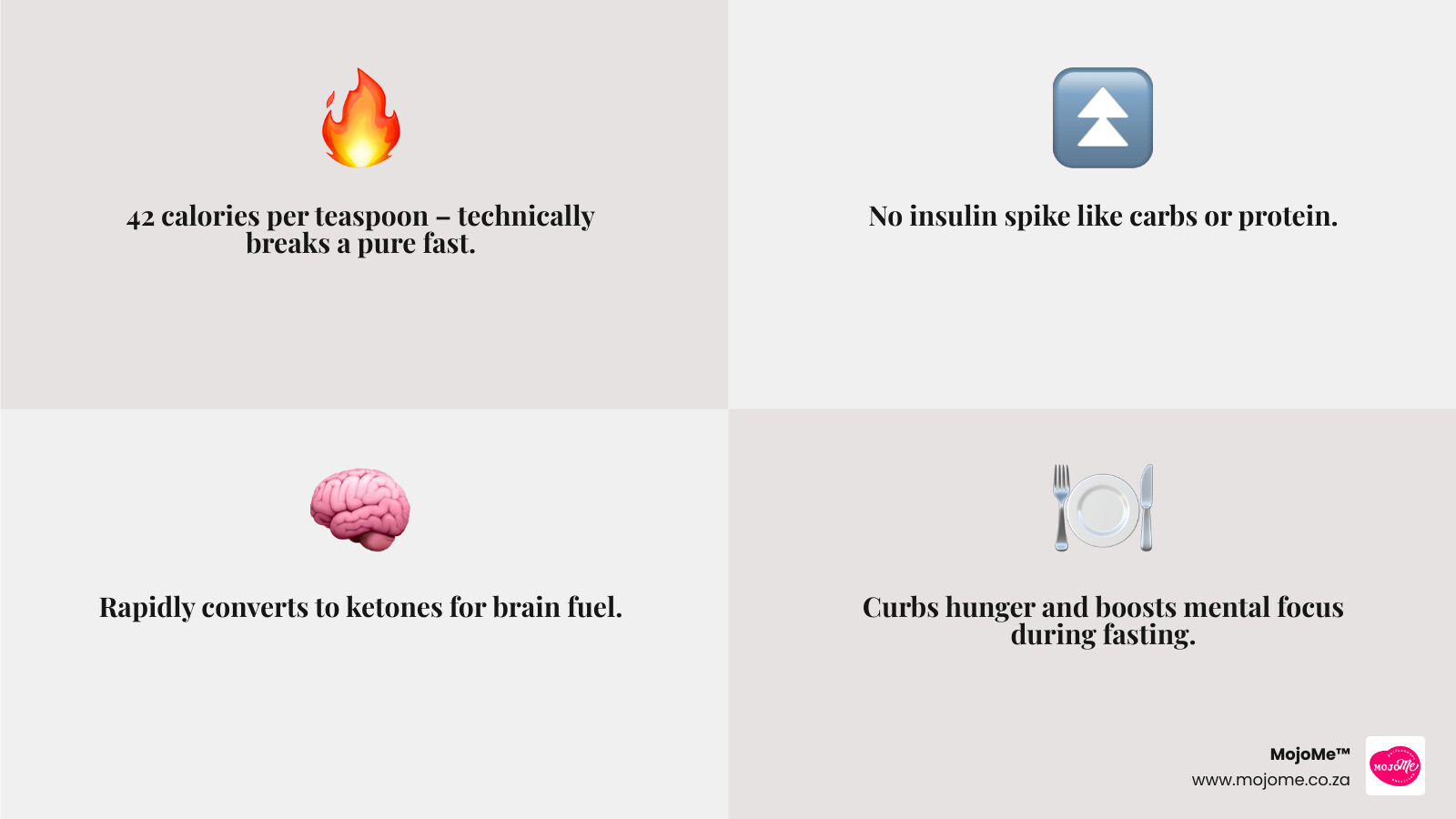
- Does MCT oil break a fast? Technically yes — it contains calories (about 42 calories per teaspoon). But it does not spike insulin the way carbs or protein do.
- Is it useful during fasting? Yes. It supports ketone production, curbs hunger, and sharpens mental focus — all without disrupting your metabolic state in any meaningful way.
- Who benefits most? People doing intermittent fasting for fat loss, mental clarity, or metabolic health (not strict autophagy fasts).
- How much should you take? Start with 1 teaspoon. Work up to 1 tablespoon max during your fasting window.
So why does this even matter?
When you fast, your body shifts from burning glucose to burning fat for fuel. That transition can feel rough — brain fog, hunger spikes, low energy. MCT oil is uniquely positioned to smooth that shift.
Unlike regular fats, MCTs (medium-chain triglycerides) bypass normal digestion entirely. They go straight to your liver and convert rapidly into ketones — your brain and body’s preferred fuel source during a fast.
Think of MCT oil as a bridge between your last meal and full fat-burning mode.
The debate isn’t really “does it break a fast?” The better question is: does it support your fasting goals? For most people doing intermittent fasting, the answer is yes.
What is MCT Oil and How Does It Work?
To understand why mct oil for fasting is so effective, we first need to look at the science of what makes these fats “medium.” Most fats in our diet, like those found in olive oil or steak, are Long-Chain Triglycerides (LCTs). These require a lot of work from your digestive system, involving bile and pancreatic enzymes, before they can be used for energy.
MCT Oil stands for Medium-Chain Triglycerides. These fats have a shorter chemical structure, typically consisting of caproic, caprylic, capric, and lauric acid. Because they have fewer carbon atoms, they don’t need the usual “scenic route” through the lymphatic system.
Instead, MCTs take the express lane. They are absorbed directly into the portal vein and travel straight to the liver. Once there, the liver converts them almost instantly into ketones. These ketones then cross the blood-brain barrier to provide immediate fuel for your neurons. This rapid absorption is why you feel a “lift” in mental clarity shortly after taking it—it is essentially rocket fuel for your brain.
MCT Oil vs. Coconut Oil vs. MCT Powder
We often get asked: “Can’t I just use coconut oil?” While we love coconut oil, it isn’t the same thing as pure MCT oil. Coconut oil vs. MCT oil is a matter of concentration. Coconut oil is about 54% MCTs, but a large portion of that is Lauric Acid (C12), which actually behaves more like a long-chain fat in the body.
Pure MCT oil is 100% medium-chain fats, usually focused on C8 (Caprylic acid) and C10 (Capric acid). C8 is the “gold standard” for fasting because it converts to ketones the fastest.
If you have a sensitive stomach, you might want to Shop MCT Oil Powder. The powder version is often easier on the digestive tract because it is bound to a carrier fiber (like acacia fiber), which slows the absorption slightly and prevents the dreaded “disaster pants” that can happen if you take too much liquid oil too fast.
Does MCT Oil for Fasting Break Your Fast?
This is the million-dollar question. To answer it, we have to define what “breaking a fast” actually means to you.
If you are a strict “water-only” faster, then yes, MCT oil breaks your fast. It has a caloric impact—approximately 121 calories per tablespoon or 42 calories per teaspoon. If your goal is a religious fast or a clinical 0-calorie fast, you should skip it.
However, for most of us, the goal of Intermittent Fasting 101 is metabolic health and weight loss. In this context, the most important factor is your insulin response. Unlike carbohydrates or protein, MCT oil doesn’t spike insulin. By keeping insulin low, you stay in a fat-burning state. This approach is often called “dirty fasting,” but we prefer to think of it as “metabolic fasting”—using a small amount of pure fat to extend your fasting window without the misery of intense hunger.
Impact on Ketosis and Autophagy
One of the main reasons people use mct oil for fasting is for sustaining ketosis. During a fast, your body naturally begins to produce ketone bodies. Adding MCT oil provides an external source of these ketones, which can help you stay in deep ketosis even if you are struggling with energy levels.
What about autophagy? Autophagy is the body’s “cellular cleanup” process where it recycles old, damaged cell parts. This process is triggered by energy deprivation (specifically the activation of AMPK and the inhibition of mTOR). While some experts argue that any calories might slow this down, others suggest that MCT oil and autophagy support might actually be possible. Because ketones themselves can signal certain protective pathways, a small amount of MCT might not significantly disrupt the cellular cleanup if it helps you fast for a longer total duration.
Benefits of Using MCT Oil for Fasting

Using mct oil for fasting isn’t just about making the fast “easier”—it’s about making it more effective. Here are the primary Benefits of MCT Oil when paired with an intermittent fasting routine:
- Appetite Suppression: MCT oil has been shown to result in increased satiety. It helps regulate hunger hormones like ghrelin and peptide YY, meaning you won’t be staring at the clock counting down the minutes until your eating window opens.
- Mental Clarity: By providing the brain with an immediate source of ketones, MCT oil helps eliminate the “brain fog” often associated with the first few hours of a fast. This boost in cognitive function is a game-changer for productivity.
- Fat Burning: MCTs are known to increase thermogenesis, which is the production of heat in the body. This essentially “revs” your metabolic engine, helping you burn more calories at rest.
Enhancing Weight Loss with MCT Oil for Fasting
Fasting is a powerful tool for promoting weight loss, and MCT oil can act as a catalyst. An analytical review of MCTs found that replacing LCTs with MCTs can lead to a modest reduction in body weight and adipose tissue (body fat) without negatively affecting cholesterol levels.
Because MCTs are rarely stored as fat and are instead used immediately for energy, they help maintain a high metabolic rate even while you are in a calorie deficit. It’s the ultimate “fat that helps you burn fat.”
How to Use MCT Oil During Your Fasting Window
If you are new to MCTs, the most important rule is: Start slow. Because MCTs bypass the normal digestive process, taking too much too soon can lead to a “gastric event” that will have you running for the nearest bathroom.
| Fasting Level | Recommended MCT Dosage | Timing |
|---|---|---|
| Beginner | 1 teaspoon (5ml) | Once in the morning |
| Intermediate | 2 teaspoons (10ml) | Morning and mid-day |
| Advanced | 1 tablespoon (15ml) | As needed for energy |
To avoid GI distress, follow our guide on Fixes for MCT Oil Pure Storage and Usage Problems. Start with just a teaspoon and see how your body reacts over a few days before increasing the dose. Also, while you are taking oil, you still need to follow Intermittent Fasting 16-8 Hydration Rules—drink plenty of water and keep your electrolytes up!
Best Timing and Coffee Recipes
The most popular way to use mct oil for fasting is in your morning coffee. This is often called “Bulletproof coffee” or “Keto coffee.”
The MojoMe Power Morning Brew:
- 1 cup of high-quality black coffee.
- 1-2 teaspoons of MojoMe Pure MCT Oil.
- Optional: A pinch of sea salt for electrolytes.
- Crucial Step: Use a small milk frother or blender to emulsify the oil. This breaks the fat into tiny droplets, making it much easier to digest and giving your coffee a creamy, latte-like texture without any dairy.
Taking your MCT oil in the morning provides a sustained energy boost that can carry you through until your first meal at lunch or later. You can also take a “mid-fast pick-me-up” dose if you feel your energy flagging around the 14-hour mark.
Frequently Asked Questions about MCT Oil for Fasting
Can I use MCT oil during extended fasts (24+ hours)?
Yes, and many people find it essential. During extended fasts, your primary goal is often hunger management and muscle preservation. MCT oil provides the brain with fuel so it doesn’t signal the body to break down muscle tissue for glucose (gluconeogenesis). It helps maintain high ketone levels, making the 24-48 hour mark much more manageable.
Who should avoid using MCT oil while fasting?
While generally safe, certain people should be cautious. If you have poorly managed diabetes, rapid ketone production could theoretically increase the risk of diabetic ketoacidosis, so always consult your doctor. Those with severe liver issues or gallbladder sensitivity should also start with very small amounts, as the liver is the primary processing plant for MCTs.
Does MCT oil help with the “Keto Flu”?
Absolutely. The “Keto Flu” is usually caused by the brain struggling to transition from glucose to ketones. By providing an immediate source of ketones, MCT oil can bridge that gap and reduce symptoms like headaches, irritability, and brain fog. Just make sure to keep your sodium and magnesium levels up as well!
Conclusion
At the end of the day, the “perfect” fast is the one you can actually stick to. If a teaspoon of mct oil for fasting helps you extend your fasting window by four hours, the metabolic benefits of those extra four hours far outweigh the 42 calories you consumed.
At MojoMe™, we are committed to providing science-backed, 100% natural nutrition from our home in Cape Town. Whether you are looking to sharpen your mind, shed a few kilograms, or simply feel more vibrant, our pure MCT products are designed to support your journey without any fillers or hidden sugars.
Ready to level up your fasting game? Shop Pure Coconut MCT Oil or Explore our range of pure medium-chain triglycerides today and feel the difference that high-quality, clean fuel can make.