What You Need to Know About Whey Protein After Workout
Whey protein after workout is one of the most effective tools for muscle recovery and growth. Here’s what the research says at a glance:
- When to take it: Within 2 hours post-workout (sooner is better, but not as critical as once thought)
- How much: 20-40g per serving (roughly 0.25-0.40g per kg of body weight)
- Why it works: Whey is fast-digesting and rich in leucine, the amino acid that directly triggers muscle protein synthesis
- Does timing matter? Yes, but total daily protein intake (1.6-2.2g per kg of body weight) matters more than the exact minute you drink it
- Do you need carbs with it? Not essential for resistance training, but beneficial for endurance athletes
You finish your last set. Your muscles are fatigued, your body is in a catabolic state, and what you do next matters.
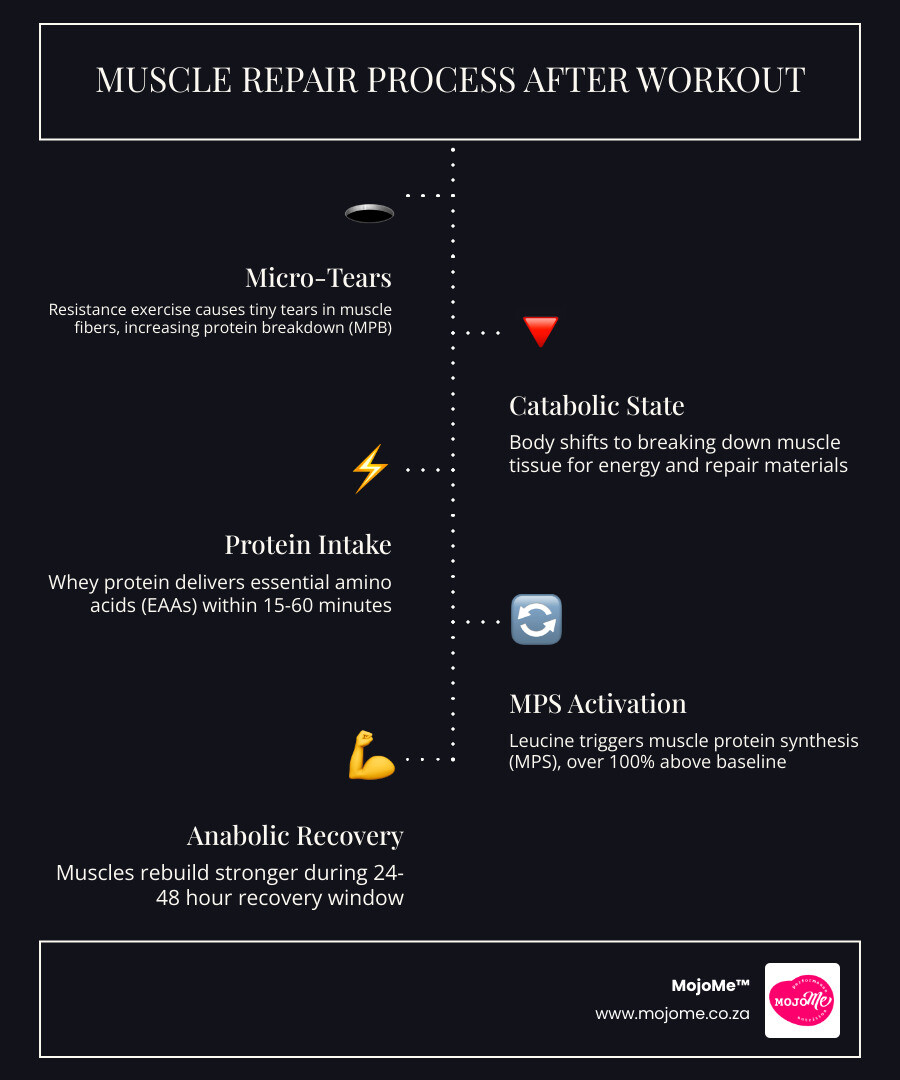
During exercise, your muscle fibers develop tiny micro-tears. This is completely normal — it’s the stimulus your body needs to grow stronger. But to repair and rebuild those fibers, your body needs one thing above all else: amino acids from protein.
That’s where whey protein comes in.
Whey is a complete, fast-digesting protein derived from dairy. It delivers all nine essential amino acids directly to your muscles — faster than almost any other protein source. Research shows that consuming 25 grams of whey protein after resistance exercise enhances tissue repair and improves acute recovery of exercise performance.
Yet there’s a lot of noise around when exactly you need to drink it, how much you need, and whether the famous “anabolic window” is real or just gym mythology. This guide cuts through the confusion with what the science actually says.
The Science of Whey Protein After Workout: Recovery and Growth
To understand why a whey protein after workout routine is so popular, we have to look at what happens inside the muscle cell. Intense exercise shifts your body into a “catabolic” state—a fancy word for breaking things down. Your muscle protein breakdown (MPB) increases significantly. To flip the switch from breaking down to building up (the “anabolic” state), you need to stimulate Muscle Protein Synthesis (MPS).
While resistance exercise alone can stimulate MPS by more than 100% above baseline, your body cannot actually build new tissue without the “bricks”—the essential amino acids (EAAs). Whey protein is the gold standard here because of its absorption speed. Unlike casein or whole food proteins that can take hours to digest, whey spikes blood amino acid levels within 15 to 60 minutes.
According to the International Society of Sports Nutrition position stand: protein and exercise, consuming whey protein after resistance exercise is a proven way to enhance tissue repair. This rapid delivery of nutrients is exactly why athletes gravitate toward our Whey Protein Category products to support their hard work in the gym.
Why Leucine is the Key to Whey Protein After Workout Success
If protein is the building block of muscle, then Leucine is the foreman at the construction site telling everyone to get to work. Leucine is one of the three Branched-Chain Amino Acids (BCAAs), and it plays a unique role in regulating protein metabolism.
Leucine acts as a biological “trigger” for the mTOR pathway (mammalian target of rapamycin), which is the primary signaling system for muscle hypertrophy (growth). Research suggests there is a “leucine threshold”—typically around 2 to 3 grams per serving—required to fully maximize the muscle-building response. Because whey protein contains about 11% leucine, a standard 25g scoop easily hits this target. For older adults, this threshold may be higher (3-4g), making the high-leucine content of whey even more critical as we age.
Reducing Muscle Soreness and Improving Performance
We’ve all felt that “waddle” the day after a heavy leg session. This is Delayed Onset Muscle Soreness (DOMS), caused by exercise-induced muscle damage. While you can’t eliminate it entirely, whey protein after workout consumption can significantly take the edge off.
Studies have shown that whey protein hydrolysate supplementation for four days following intense exercise reduced symptoms of muscle damage and improved the recovery of muscle function. By providing a rapid stream of amino acids, you’re giving your body the tools to patch up those micro-tears faster. For those focusing on long-term structural health, we also recommend looking into Muscle Soreness with Proper Collagen Usage for Athletes to support connective tissues alongside your muscle-building whey.
Debunking the Anabolic Window: When is the Best Time to Drink Your Shake?
For decades, gym culture insisted on the “30-minute window”—the idea that if you didn’t chug your shake before leaving the locker room, your workout was wasted. We have good news: science has moved on.
The “anabolic window” is more like a large “anabolic garage door” that stays open for quite a while. Recent research, including a study showing that pre- vs. post-exercise protein intake has similar effects, suggests that your muscles remain sensitized to protein for 24 to 48 hours after training.
However, “sooner” is still a great strategy, especially if you trained in a fasted state (like first thing in the morning). If you haven’t eaten in 4+ hours, getting that shake in within 60 minutes is a smart move to halt muscle breakdown. If you’re worried about your powder not blending smoothly during that post-gym rush, check out our tips on Protein Powder Supplements: Solving Mixing Issues.
Total Daily Intake vs. Precise Timing
While we love a good post-workout ritual, the “big picture” matters most. As exercise scientist Brad Schoenfeld notes, perceived benefits often result from total consumption rather than timing. If you are hitting your total daily protein goal (1.6g to 2.2g per kg of body weight), the exact minute you drink your shake becomes less critical.
Think of your body like a ledger rather than a stopwatch. What matters is that the “protein account” is well-funded by the end of the day. Strategic timing is a “multiplier”—it adds an extra 5-10% of efficiency—but the foundation is your total daily intake.
The Benefits of Pre-Sleep Protein for Overnight Repair
Sleep is when the real magic happens. This is your body’s primary time for repair and hormonal regulation. Research shows that protein before sleep maximizes muscle adaptation and overnight synthesis.
Consuming 30-40g of protein before bed can improve strength gains and muscle size over time. While slow-digesting casein is often recommended for nighttime, whey can also work well, especially if you’ve trained in the evening. It ensures your body has a “pool” of amino acids to draw from while you’re in dreamland, preventing the catabolic state that can occur during an overnight fast.
Optimizing Your Dose: How Much Whey Protein Do You Really Need?

The “standard” advice is usually one scoop (about 25g), but your needs might vary based on your size and the intensity of your session.
For most people, a dose of 20-25 grams of high-quality whey is enough to max out muscle protein synthesis. However, a groundbreaking 2023 study found that ingesting 100g protein results in a prolonged anabolic response lasting over 12 hours. While we aren’t suggesting you drink four scoops at once, it does debunk the myth that your body can “only absorb 20g at a time.”
| Goal / Body Type | Recommended Post-Workout Dose |
|---|---|
| General Fitness (60-70kg) | 20 – 25g |
| Strength/Hypertrophy (80kg+) | 30 – 40g |
| Endurance Recovery | 20g + Carbs |
| Older Adults (50+) | 35 – 40g |
Factors Influencing Your Optimal Protein Dose
Your age and training style play a big role. As we get older, our muscles become less sensitive to protein—a condition called “anabolic resistance.” This is why protein ingestion requires greater relative intake in older men compared to younger lifters to achieve the same growth stimulus.
Training intensity also matters. If you’ve just done a full-body session or a high-volume leg day, your body may benefit from a higher dose (up to 40g) compared to a light “arm day.”
Do You Need to Combine Whey with Carbohydrates?
This is a classic debate. The theory is that carbs spike insulin, which helps “shuttle” protein into the muscles. While insulin is indeed anabolic, research has shown that co-ingestion of carbs does not further augment synthesis if you’ve already consumed enough protein. Whey protein is actually insulinogenic on its own!
However, carbs are still vital for replenishing glycogen (your muscle’s energy stores). If you are an endurance athlete or training again within 8 hours, adding a banana or some oats to your shake is a great idea. For standard weightlifting, the protein alone is usually sufficient for muscle growth.
Selecting the Best Whey Protein After Workout: Isolate vs. Concentrate
When shopping for whey protein after workout options, you’ll usually see two main types: Concentrate and Isolate.
- Whey Concentrate: Usually 70-80% protein. It contains some healthy fats and a bit more lactose. It’s a great, cost-effective option for most people.
- Whey Isolate: Processed further to remove almost all fat and lactose, resulting in 90%+ protein. Our Mojome Pure Whey Isolate is perfect for those who want the fastest absorption and the lowest calorie count.
If you struggle with “clumping” in your shakes, especially with high-purity powders, read our guide on Preventing Clumping in Sugar-Free Protein Powder.
Why Whey Isolate is Superior for Post-Workout Use
For the immediate post-workout window, Isolate often takes the crown. Because it is virtually fat-free, it exits the stomach and enters the bloodstream even faster than concentrate. This rapid insulinogenic response helps manage cortisol levels (the stress hormone) that spike during training.
Furthermore, whey protein alone improves strength and fat-free mass effectively because it provides the highest concentration of EAAs per gram of powder. If you have a sensitive stomach or are lactose intolerant, Isolate is almost always the better choice.
What to Look for in a High-Quality Supplement
Not all tubs of protein are created equal. Many commercial brands pack their powders with “fillers”—maltodextrin, thickeners, and artificial sugars that can cause bloating. When browsing our Sports Nutrition Category, you’ll notice we focus on purity.
Always look for:
- Minimal Ingredients: You want protein, not a chemistry set.
- Amino Acid Profile: Ensure it’s a complete protein with high BCAA content.
- Third-Party Testing: This ensures what’s on the label is actually in the tub.
Safety and Effectiveness for All Athletes
One of the biggest myths in fitness is that “high protein diets are bad for your kidneys.” Let’s put that to rest: high protein diets are safe for healthy individuals with normal kidney function. Your body is incredibly efficient at processing protein, and for athletes, the benefits far outweigh the imaginary risks.
In fact, higher protein intake is associated with better bone health, as it increases bone mineral density when combined with strength training. For endurance lovers, we also recommend pairing your protein with Collagen for Athletes: Support Recovery After Long Runs to keep your joints as strong as your muscles.
Whey Protein for Endurance and Team Sport Athletes
Whey isn’t just for bodybuilders. If you’re a runner, cyclist, or soccer player, whey protein after workout consumption is a game-changer. Research on marathon runners showed that whey improves marathon-induced injury markers, specifically lowering markers of muscle damage like Creatine Kinase (CK).
For team sports like soccer, post-game protein has been shown to improve high-intensity running performance in subsequent matches. It also supports your immune system, which can be suppressed after long, grueling endurance sessions.
Debunking Common Myths About High-Protein Diets
- Myth 1: It damages kidneys. As mentioned, no evidence suggests high protein harms healthy kidneys. Weightlifters have been consuming high-protein diets for decades with perfectly healthy renal markers.
- Myth 2: It causes bone loss. The opposite is true. Protein is a major structural component of bone.
- Myth 3: You can only absorb 20g. Your body will absorb almost all the protein you eat; it just might use the “extra” for other bodily functions or energy rather than just muscle synthesis.
Frequently Asked Questions about Whey Protein After Workout
Is it better to drink whey protein with water or milk after a workout?
If your goal is fast absorption, water is best. Fat in milk can slow down the digestion of the protein. However, if you are trying to gain weight (bulking) or simply prefer the taste, milk adds extra calories and a bit more protein.
Can I take whey protein on an empty stomach in the morning?
Absolutely. After an overnight fast, your body is in a catabolic state. A morning whey shake quickly delivers amino acids to stop muscle breakdown and kickstart your metabolism. It’s also very satiating, which can help with weight management.
Does whey protein help with weight loss as well as muscle gain?
Yes! Protein is the most satiating macronutrient. Research shows that high-protein snacks can help you consume significantly fewer calories at your next meal. By preserving lean muscle mass while you’re in a calorie deficit, whey helps keep your metabolic rate high.
Conclusion
Drinking whey protein after workout sessions is more than just a gym ritual—it’s a science-backed strategy to ensure your hard work doesn’t go to waste. By providing a rapid source of essential amino acids and leucine, you trigger the repair process, reduce soreness, and build the lean muscle you’re after.
While the “anabolic window” is wider than we once thought, consistency is the real key. Focus on your total daily protein intake, distribute it evenly throughout the day, and use high-quality, pure supplements to avoid unwanted fillers.
At MojoMe™, we believe in pure, potent nutrition. No fillers, no sugars, just the science-backed ingredients your body needs to thrive.
Ready to optimize your recovery?