Why Finding a Safe Gluten Free Fibre Supplement Is Harder Than It Should Be
A gluten free fibre supplement is a dietary supplement that helps you meet your daily fibre needs without any gluten-containing ingredients or cross-contamination risk. Here are the safest, most widely available options:
Top gluten free fibre supplements at a glance:
| Supplement | Fibre per Serving | Key Feature |
|---|---|---|
| Psyllium husk powder | 6g soluble + 1g insoluble | Naturally gluten free |
| Inulin (prebiotic powder) | 3g soluble | Dissolves clear, tasteless |
| Acacia fibre powder | 5g soluble | Gentle, low bloating risk |
| Flaxseed meal | 2g mixed | Adds omega-3 fatty acids |
| Methylcellulose powder | 2g soluble | Wheat free, synthetic option |
Getting enough fibre is a challenge for most people. The average person gets roughly half of the recommended 20 to 35 grams per day. For people managing coeliac disease or gluten sensitivity, this gap is often even wider.
Why? Because many fibre-rich staples, think wholegrains, wheat bran and rye bread, are completely off the table. Gluten-free alternatives tend to be more refined and lower in fibre. That means digestive support, bowel regularity and gut health all take a hit.
And here is where it gets complicated. Not every fibre supplement labelled “gluten free” is equally safe. Some are processed on shared equipment. Others use wheat-derived ingredients like wheat dextrin that technically fall below the legal threshold of 20 parts per million, but may still cause reactions in highly sensitive individuals.
Finding a supplement you can trust requires knowing what to look for, and what to avoid.
The Importance of a Gluten Free Fibre Supplement
When we remove gluten from our diets, we often inadvertently remove the primary sources of roughage that keep our digestive systems moving. Research suggests that many gluten-free processed foods contain less fibre and more sugar or salt than their gluten-containing counterparts. For those of us in South Africa navigating this dietary landscape, a gluten free fibre supplement becomes more than just an “add-on”; it is often a necessity for maintaining long-term colon health.
Fibre does more than just prevent constipation. It acts as a prebiotic to feed the “good” bacteria in your gut, helps regulate blood sugar levels and can even contribute to heart health by managing cholesterol. For individuals with coeliac disease, whose gut lining may have suffered previous damage, the right kind of fibre is essential for soothing the digestive tract and ensuring nutrient absorption is optimised.

Choosing a Gluten Free Fibre Supplement for Coeliac Disease
If you have been diagnosed with coeliac disease, your tolerance for trace gluten is effectively zero. According to Gluten and food labelling, a product must contain fewer than 20 parts per million (ppm) of gluten to be legally labelled gluten-free. However, for the highly sensitive, even this tiny amount can cause issues if the supplement is taken daily.
We recommend looking for products that are explicitly labelled as being produced in a dedicated gluten-free facility. Some popular brands use wheat dextrin. While the processing of wheat dextrin removes gluten to a level that meets legal standards, some South African consumers prefer to stick to naturally gluten-free sources like psyllium, acacia or flax to avoid any risk of a reaction. Always check for the “cross” symbol or a clear “Gluten-Free” statement on the back of the tub.
Recommended Daily Intake for South Africans
How much do we actually need? Nutritional experts generally suggest an intake of 20 to 35 grams of fibre daily. Unfortunately, statistics show that the average adult only consumes about 15 grams per day. When you factor in the restrictions of a gluten-free diet, that number can drop even further.
To bridge this gap, incorporating a supplement that provides between 5 and 10 grams per serving can get you back on track. For more detailed guidance on meeting these targets, you can explore Increasing fibre intake.
Soluble vs Insoluble Fibre Benefits
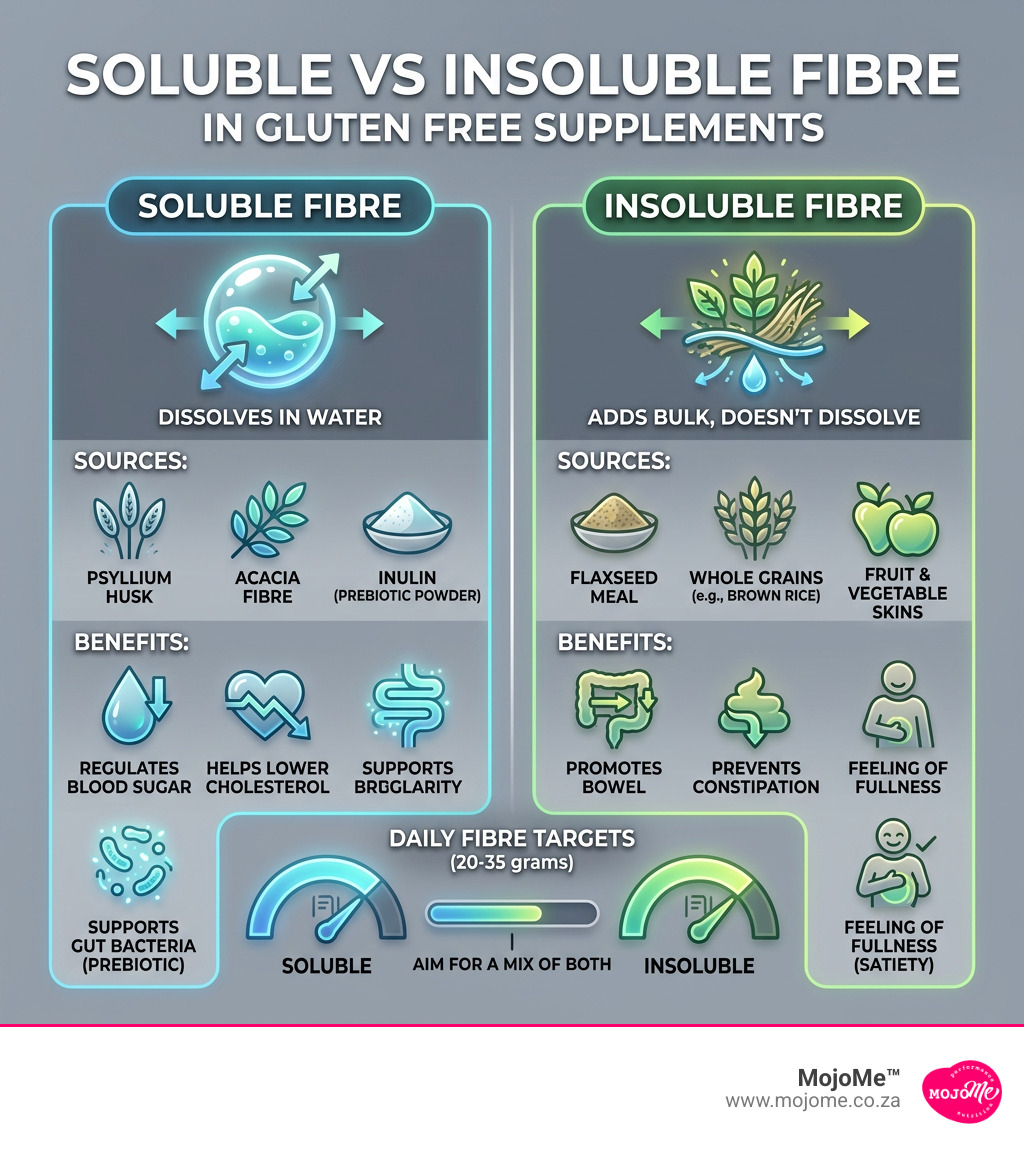
Not all fibre is created equal. A high-quality gluten free fibre supplement will often contain a blend of both soluble and insoluble fibres, as they perform very different roles in your body.
Soluble Fibre Characteristics
Soluble fibre dissolves in water to form a gel-like substance. Think of it as a sponge that travels through your system. Its primary benefits include:
- Heart Health: It binds to cholesterol particles and flushes them out.
- Blood Sugar Control: It slows down the absorption of sugar, preventing insulin spikes.
- Satiety: It keeps you feeling full for longer, which is great for weight management.
- Common Sources: Psyllium husk, inulin (from chicory root) and glucomannan.
A typical serving of a soluble-heavy supplement might provide around 5 grams of fibre per 15 millilitre dose.
Insoluble Fibre Characteristics
Insoluble fibre is the “roughage.” It does not dissolve in water and remains relatively intact as it moves through your digestive system.
- Bowel Regularity: It adds bulk to the stool and helps food pass more quickly through the stomach and intestines.
- Prevention: It is the go-to for preventing that sluggish, heavy feeling.
- Common Sources: Flaxseed meal, bamboo fibre and various fruit skins.
Most supplements offer a smaller ratio of insoluble fibre, often around 1 gram per serving, to complement the bulking effects of the soluble components.
Top Ingredients in a Gluten Free Fibre Supplement
When browsing the aisles or shopping online in South Africa, you will notice a few recurring ingredients. Understanding these will help you choose a product that suits your gut’s unique needs.
Psyllium Husk Powder
Psyllium is perhaps the most famous gluten free fibre supplement ingredient. Derived from the seeds of the Plantago ovata plant, it is almost entirely fibre. A standard 15 millilitre serving (roughly one tablespoon) usually offers 6 grams of soluble fibre and 1 gram of insoluble fibre.
It is a “bulking” fibre, meaning it absorbs a significant amount of liquid. This makes it highly effective for both constipation and mild diarrhoea, as it regulates the consistency of the stool. It is also naturally keto-friendly and vegan.
Inulin and Vegetable Fibres
Inulin is a prebiotic fibre often extracted from chicory root or blue agave. It is popular because it is completely soluble and has a slightly sweet, pleasant taste. It does not thicken liquids like psyllium does, so you can stir 10 millilitres into your coffee or tea without even noticing it is there. It typically provides about 3 grams of soluble fibre per dose and is excellent for feeding the Bifidobacteria in your colon.
Synthetic and Alternative Fibres
For those with extremely sensitive stomachs who find natural plant fibres too fermentable (leading to gas), synthetic or highly refined options exist:
- Methylcellulose: A non-fermentable fibre that is less likely to cause flatulence.
- Calcium Polycarbophil: Often found in tablet form, it acts as a bulk-forming agent.
- Polydextrose: A synthetic polymer of glucose used to boost fibre content in “fit” snacks and gummies.
How to Introduce Fibre Safely
One of the biggest mistakes people make when starting a gluten free fibre supplement is taking a full dose on day one. If your body isn’t used to it, you are going to feel like a balloon.
Managing Side Effects
To avoid bloating and gas, we recommend the “low and slow” approach:
- Start Small: Begin with just 2 grams (about half a teaspoon) daily for the first week.
- Monitor: See how your digestive transit time changes.
- Increase Gradually: Add another 2 grams each week until you reach the recommended serving size.
- Hydrate: This is non-negotiable. In the South African heat, fibre can actually cause constipation if you aren’t drinking enough water. Aim for at least 250 millilitres of extra water for every serving of fibre you take.
Best Practices for Consumption
For the best results, consistency is key. Try to take your supplement at the same time every day.
- Mixing: If using psyllium, drink it immediately after mixing, or it will turn into a thick gel that is difficult to swallow.
- Timing: Taking fibre about 30 minutes before a meal can help with satiety and blood sugar regulation.
- Temperature: Most powders dissolve best in cool or room-temperature liquids. Carbonated drinks are generally not recommended as they can increase the feeling of bloating.
Frequently Asked Questions
How to assess the safety and gluten-free status of fibre supplements?
Always look for the “Certified Gluten-Free” seal. Some commercial fibre powders and capsules are labelled gluten-free, but it is important to be cautious of associated products like fibre wafers which may contain wheat flour. Similarly, some supplements are made from wheat dextrin. While these are legally gluten-free and safe for most people with coeliac disease, individuals with high sensitivity should monitor their reaction. For a pure, plant-based option, a high-quality psyllium husk that is explicitly labelled free of wheat and gluten is a reliable choice.
What are the best natural gluten-free food sources?
Supplements should complement a healthy diet, not replace it. Some of the best South African-friendly sources of fibre include:
- Chia Seeds: 10 grams of fibre per 28 grams.
- Flaxseeds (Linseeds): Excellent for both fibre and Omega-3.
- Berries: Raspberries and blackberries are fibre powerhouses.
- Avocado: A medium avocado provides about 10 to 13 grams of fibre.
- Legumes: Lentils and chickpeas (ensure they are processed in gluten-free environments).
How much should a gluten free fibre supplement cost in South Africa?
Prices vary depending on the purity and the source. Generally, you can expect to pay anywhere from R150 to R450 for a high-quality container. While some bulk psyllium husks might seem cheaper, ensure they are food-grade and tested for heavy metals and gluten cross-contamination. Investing in a premium product ensures you aren’t consuming hidden fillers or sugars.
Conclusion
At MojoMe, we believe that gut health is the foundation of overall wellness. Navigating a gluten-free lifestyle in Cape Town and beyond shouldn’t mean sacrificing your digestive comfort. By choosing a high-quality gluten free fibre supplement and pairing it with whole, natural foods, you can ensure your body gets the roughage it needs to thrive.
Whether you prefer the traditional bulking power of psyllium or the prebiotic benefits of inulin, the key is to stay hydrated and listen to your body. Our commitment to 100% natural, filler-free nutrition means you can focus on feeling your best without worrying about what is hidden in the fine print.
Shop MojoMe natural supplements to discover our range of science-backed, award-winning products designed for your health journey.